
Finding Star

Why so happy?
Evening sunlight shone on the star-ring on the desk. The gold at the bottom of the ring had grown a little wider again. From inside the ring came a voice telling a story. "Komo, someone is telling a story!" Komo, on her shoulder, held up three fingers. "Today we'll hear three stories that Jesus told. In every story someone says, 'Rejoice with me.' Listen to the end to find out why they are so happy." Nuri lifted the ring. "Today we only watch and listen from far away again, right?" "Right."

He welcomes sinners
Beyond the star-ring, a small village could be seen. "Now all the tax collectors and sinners were coming close to him to hear him." Tax collectors gathered taxes, and many people disliked them. Jesus sat down at the same table with people like that. The Pharisees and the scribes saw it and grumbled. "This man welcomes sinners, and eats with them." Nuri tilted her head. "Why is eating together strange?" Komo whispered, "Those people thought, 'We don't eat with sinners.'" Then Jesus told a story to the people who were grumbling.

Leave the ninety-nine
A story picture opened before Nuri's eyes. "Which of you men, if you had one hundred sheep, and lost one of them, wouldn't leave the ninety-nine in the wilderness, and go after the one that was lost, until he found it?" In the story, a shepherd counted his sheep in the field at sunset. Ninety-eight, ninety-nine… one was missing. From somewhere among the rocks came a tiny cry. The shepherd took his staff and walked straight toward the sound.

Rejoice with me
The shepherd found the sheep trembling between the rocks. "When he has found it, he carries it on his shoulders, rejoicing." "When he comes home, he calls together his friends and his neighbors, saying to them, 'Rejoice with me, for I have found my sheep which was lost!'" Everyone was happy together. Jesus said, "I tell you that even so there will be more joy in heaven over one sinner who repents, than over ninety-nine righteous people who need no repentance." Komo whispered, Retold "When one person comes back to God, heaven is very, very glad." Nuri said softly,
God keeps looking until he finds.
Light a lamp and sweep
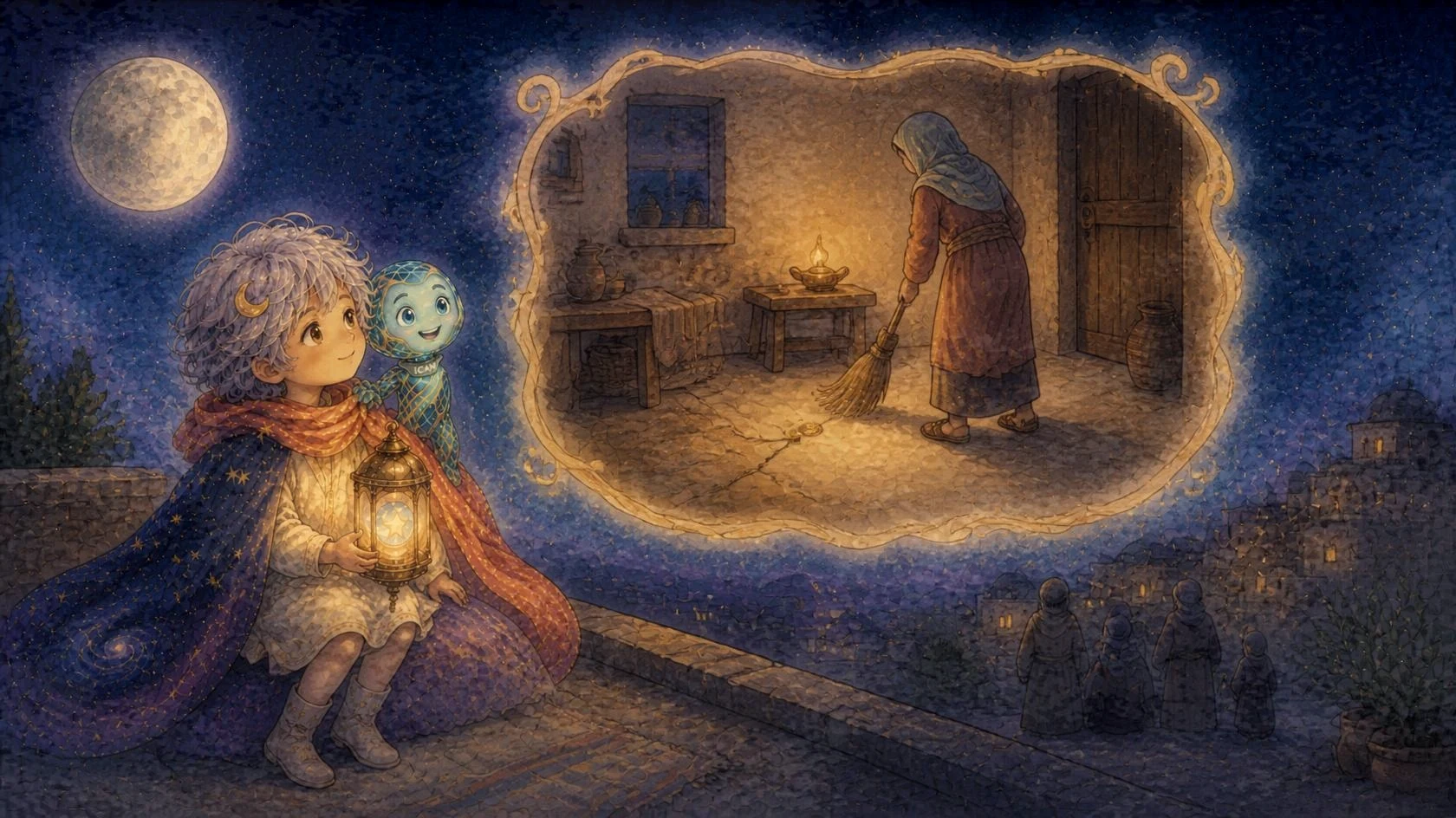
Jesus told another story. "Or what woman, if she had ten drachma coins, if she lost one drachma coin, wouldn't light a lamp, sweep the house, and seek diligently until she found it?" A drachma was a coin made of silver. In the story, the woman lit a small lamp and swept every corner of the floor. Then — a twinkle! She found the coin. She called her friends and neighbors: "Rejoice with me, for I have found the drachma which I had lost." Again everyone was happy together. Jesus said, "Even so, I tell you, there is joy in the presence of the angels of God over one sinner repenting." Nuri said softly,
God keeps looking until he finds.
He wasted his property
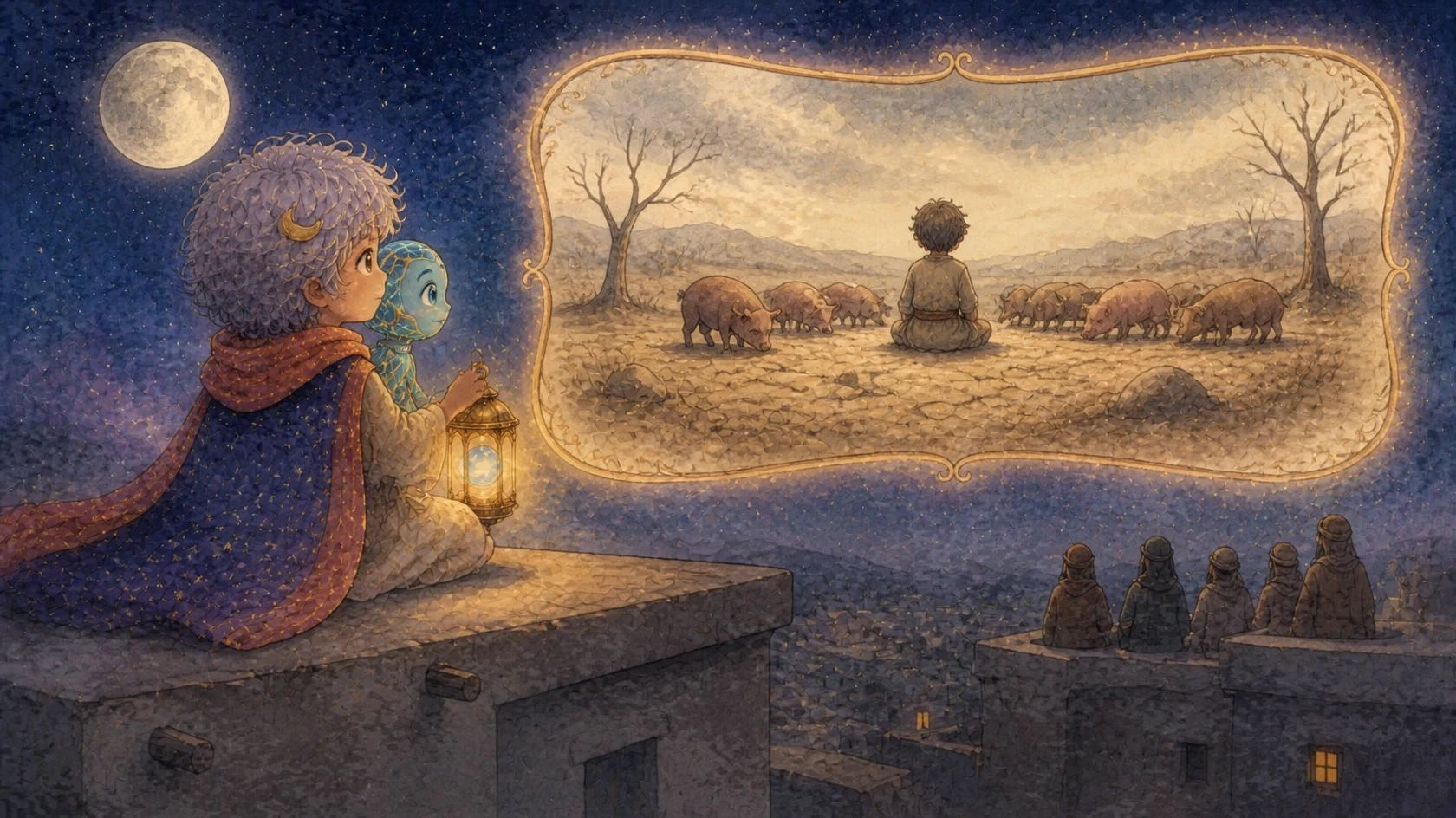
Next Jesus told a story about a father and two sons. "A certain man had two sons." In the story, the younger son asked his father for his share of the property. The father divided it. The younger son "traveled into a far country. There he wasted his property with riotous living." When the money was all gone, a severe famine came to that country. The younger son ended up feeding pigs in someone else's fields. He was so hungry he wanted to eat even the pigs' food, "but no one gave him any." Nuri took a small breath. "He must have been hungry and so lonely."
He came to his father
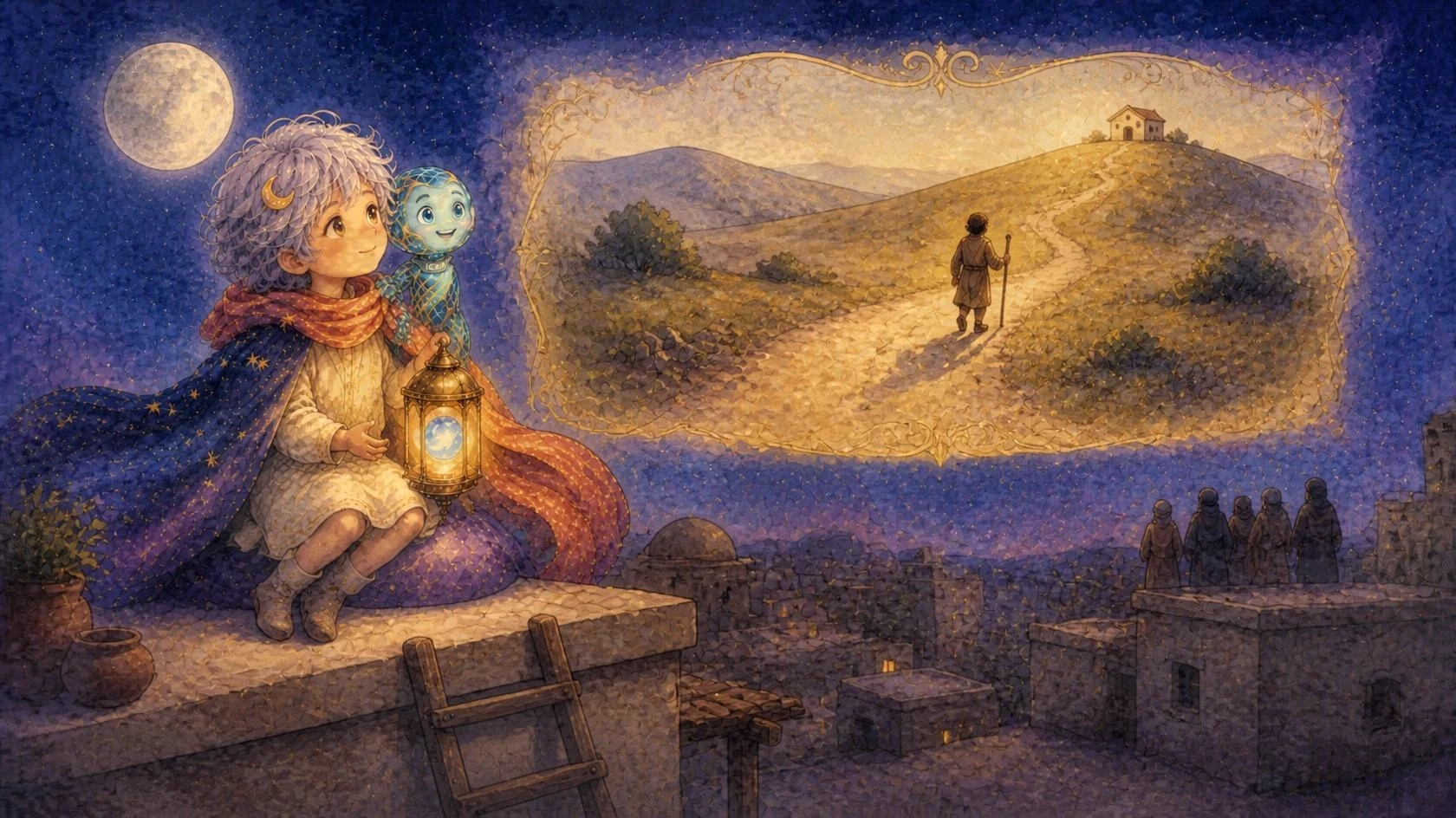
"But when he came to himself he said, 'How many hired servants of my father's have bread enough to spare, and I'm dying with hunger!'" The younger son got ready in his heart what he would say to his father: "Father, I have sinned against heaven, and in your sight. I am no more worthy to be called your son. Make me as one of your hired servants." A hired servant is a worker who is paid each day. "He arose, and came to his father."

Moved with compassion
"But while he was still far off, his father saw him, and was moved with compassion, and ran, and fell on his neck, and kissed him." The son said, "Father, I have sinned against heaven, and in your sight. I am no longer worthy to be called your son." But the father said to his servants, "Bring out the best robe, and put it on him. Put a ring on his hand, and shoes on his feet." And he told them to get a feast ready: "Let us eat, and celebrate." Nuri's eyes grew wet. "The father ran to him first."

Dead and alive again
The father said, "This, my son, was dead, and is alive again. He was lost, and is found." "They began to celebrate." This time there was a feast at home. Komo held up three fingers again. Nuri said softly,
God keeps looking until he finds.

His father came out
Just then the elder son, who had been in the field, came near the house. He heard music and dancing. He heard that his brother had come back and there was a feast. "But he was angry, and would not go in. Therefore his father came out, and begged him." The elder son said, Retold "For years I have served you and never disobeyed you. But you never gave me even a young goat to celebrate with my friends." Nuri said softly, "Sometimes I feel like that too. It would feel unfair." The father said, "Son, you are always with me, and all that is mine is yours." And he said, "But it was appropriate to celebrate and be glad, for this, your brother, was dead, and is alive again. He was lost, and is found." Jesus' story stopped there.

The planet that was found
On the way back, Komo showed one tiny blue dot, very far away, inside the star-ring. "That's a planet called Neptune. It's so far and so dim that you can't see it with your eyes alone." "Then how did people know?" "Long ago, scientists saw that Uranus moved a little strangely, and they worked out, 'Something must be out there.' Le Verrier calculated where to look, and Galle looked near that spot with a telescope — and found it that very night!" Nuri clapped her hands. "How happy they must have been when they found it!"
Today's sky
- Neptune is the eighth planet from the Sun. You can't see it with your eyes alone
- On the night of 23 September 1846, Galle found Neptune less than 1 degree from where Le Verrier had calculated (NASA)

The one who looks for us
Back home, Nuri put down the star-ring and said, "Now I get it. The sheep, the coin and the son were all lost and then found again, and everyone was happy together." Komo nodded. "Jesus said heaven is this happy when one person comes back to God. And on another day, at the house of a tax collector named Zacchaeus, he said, 'For the Son of Man came to seek and to save that which was lost.' 'Son of Man' is a name Jesus used for himself." Nuri looked out the window.
God looks for every lost person until he finds them, and when he finds them he is full of joy.
"God knows me, and God looks for me too." Nuri folded her hands. "God, thank you for knowing me, finding me and being glad over me. In Jesus' name. Amen."
Eight Finding Star cards
Tap a card to flip it. Put the eight cards in order and tell today's stories again.

Four thinking games
- 1[After reading] Analysis · Three-story chart: in three columns (sheep · coin · son), fill in 'what was lost · how it was found · what happened after · what Jesus said' with a picture or one word, then circle what is the same.
- 2[After reading] Understanding · The father's two walks: draw a road on the floor and trace with a finger the father 'running' to the younger son and 'coming out' to the elder son.
- 3[Class] Find the coin: hide one shiny paper coin in the room and look for it together with a flashlight. When it's found, shout together, "Rejoice with me!" Then put it back in the basket. The coin is just a game piece.
- 4[Class] Prediction · Look at the back cover. On a windy night sea, what will happen to the small boat? What is the clue?
[Home] One thank-you: before bed, pick one moment when God cared for you today and say, "God, thank you for knowing me and caring for me today." If words are hard, draw it.
God looks for every lost person until he finds them, and is full of joy. Who will I tell this good news today?

Class flow and what to look for
- Prepare
- 8 cards, a three-story chart, a shiny paper coin, a flashlight. Write the refrain "God keeps looking until he finds." on a big sheet. Reading takes about 25 minutes. For a 20-minute class: on p11 show only the picture (10 seconds) and skip the box; on p6 read only the first quote and shorten to 'The younger son spent all his money and became hungry and lonely.' At each pause, let everyone answer first with fingers, pictures or a partner, then hear one or two answers.
- Reading flow (about 25 min)
- [0–8 min · pp. 1–4] p1 point to Komo's three fingers → p2 read the grumbling softly → p3 count "ninety-eight, ninety-nine…" together, Prediction (1 min); don't drag it out, open p4 right away → p4 read "Rejoice with me" joyfully, refrain together. · [8–17 min · pp. 5–8] p5 flashlight at "a twinkle!" → refrain → p6 lower your voice, read slowly; don't mock the younger son, read him as 'someone hungry and lonely' → p7 Inference (1 min) → p8 pause 2 seconds before "ran". · [17–25 min · pp. 9–12] open the three-story chart just before p9. Refrain, Analysis (main skill, 2 min) pointing at the chart → p10 Understanding (1 min) → p11 picture 10 seconds → p12 prayer (only children who want to repeat it).
- What to look for
- In all pauses, see whether the child links a clue to an idea. Pointing counts. p3 Prediction — sprout: a guess · stem: a clue ("until he found it", going straight toward the cry) · fruit: checks or changes the guess on p4. p7 Inference — sprout: one idea · stem: a clue ("as one of your hired servants") · fruit: compares what the son expected with what the father does on p8. p9 Analysis (main skill) — sprout: one story · stem: compares two · fruit: what the three share (lost · found · rejoicing together) and how they differ (one of a hundred · one of ten · one of two / the sheep and coin are brought back by the seeker, while the son is seen first by the father, who runs to meet him on the way / only the third has a feast at home and an elder son). p10 Understanding — sprout: one thing the father did · stem: what he did for both sons · fruit: links it to who heard the story (15:2).
Good answers and child protection
- Good answers
- p3: 'He'll hug it' and 'He'll scold it' are both good answers if there's a reason; check right away on p4. p7: 'He thought he'd be scolded' and 'He thought he'd be taken as a worker' are both good; comparing with p8 is fruit. p9: one sameness ('everyone was happy together') and one difference ('the father ran to meet the son') is fruit. p10: 'He ran to the younger son and came out to coax the elder' and 'He told it to the grumblers' are both fruit. 'Did he go in?' has no right answer.
- A child who has been lost
- A child who has been lost in a shop or on the street may feel scared on p3. They may look away from the picture or sit next to you. Point to the shepherd going 'straight' toward the cry and carrying the sheep home 'rejoicing'.
- A child living apart from family
- For a child whose family works far away (e.g. overseas workers), don't let p6 become 'people who leave are bad'. The younger son's problem was not going far, but leaving his father and living carelessly. To a waiting child say, "Your family far away is thinking of you while they work. God knows and cares for you and your family."
- A child who fears a father or has none
- Don't ask children to compare the father in the parable with their own father, and don't make them repeat the word 'father'. To a child who has lost a father or been hurt by one, say first, "God knows you best and loves you."
- When a child tells of danger
- ① Don't question them in front of others. "Thank you for telling me. It's not your fault." ② Don't promise to keep a secret: "I need to tell an adult who can help you." ③ Write down their exact words with the date. Don't confront the carer or the suspected person. ④ Tell your church's or school's child-protection lead that day; if there is none, or they are involved, report it yourself. If the child is in danger now, call emergency services. In Korea, call 112 (child-abuse reports; Ministry of Health and Welfare / National Center for the Rights of the Child guidance); for help with procedures, the Health and Welfare Call Center 129. In the Philippines, call 911 (national emergency) if there is danger now; for child-abuse reports and counselling, Bantay Bata Helpline 163, which now runs online instead of by phone (Facebook facebook.com/bantaybata163PH, Viber "Bantay Bata Helpline 163", email bantaybata163@abs-cbnfoundation.com). [Checked on the official sites on 19 October 2026] At home, if a child says 'My dad is scary,' don't correct them; listen first.
Hard questions
- "Did God lose me?"
- The parables don't mean God loses people by mistake. The sheep and coin show people who have wandered away from God, and they say God goes looking first. Tell the child, "God always knows you. And he comes looking first for people who are lost."
- "So can I do bad things?"
- "Good question. While he was away from his father, the younger son was hungry and lonely. And before his father he said, 'I have sinned' (p8). The father was so glad he said his son 'was dead, and is alive again.' Leaving God is sad; coming back to God is joyful." Grace is not permission to leave again; it is the love that brings us home.
- The elder son's heart
- It's okay to say that the elder son felt angry and treated unfairly. The father came out and listened. But that doesn't make putting his brother down right. The elder son is also a son the father loves (15:31 "you are always with me"). Don't let children mock the Pharisees and scribes. With this story, Jesus can be seen inviting the grumblers, like the elder son, to come in to the feast. The child text leaves the ending open.
- "Are some people without need of repentance?"
- The Bible says, "for all have sinned, and fall short of the glory of God" (Rom 3:23). On p4, the "righteous people who need no repentance" calls to mind people who see themselves that way.
- Genre
- Parables. The grumbling in 15:1–2 frames all three (15:3 "He told them this parable"). The three run 'lost → found → rejoicing together'. In the first two, friends and neighbors are called with "Rejoice with me"; the feast (calf, music) appears only in the third. The third ends without the elder son's answer, so the hearers must answer. The shepherd, woman and father are story characters who show God's heart. The father in the pictures is an ordinary man in a parable, not a picture of God; never describe God the Father with this old man's body or face.
Faith-language check · Reading parables
- Words
- tax collector = someone who collected taxes for Rome · Pharisees = people who tried hard to keep God's law carefully · scribes = people who copied and taught the Scriptures · sinners = (p2) people others pointed at as 'bad'; the Bible says all people need to come back to God · righteous = (p4) people who think 'I am right' · welcome = receive gladly · repent = turn from wrong and come back to God · drachma = a silver coin · angels of God · property = house, land and money · riotous living = careless spending · famine = a year with too little food · came to himself = came to his senses (not 'did well by his own strength') · hired servant = a worker paid by the day · compassion = deep pity · Son of Man = a name Jesus used for himself
- Repentance and grace
- "Repent" in 15:7, 10 means coming back to God. The sheep and coin can't come back by themselves; the seeker moves first. The son saw his wrong and came back, and the father saw him "while he was still far off" and ran before he said a word. In this story the father doesn't go to the far country, so on p9 point to 'God who sees first and runs to meet us'. We are saved not because we are good but by the grace of God who seeks. Jesus came "to seek and to save that which was lost" (Luke 19:10, said at Zacchaeus' house). Jesus said, "I am the good shepherd. The good shepherd lays down his life for the sheep" (John 10:11); we meet that in Book 6, Love Star.
- Neptune · science as wonder
- On the night of 23 September 1846 (some sources say the 24th, as it was near midnight), Galle and d'Arrest found Neptune within 1 degree of where Le Verrier had calculated (NASA). In England, Adams also calculated it separately. 'That very night' means the first night that team searched the calculated spot. God "counts the number of the stars. He calls them all by their names" (Ps 147:4). This is a window to feel the joy of finding; science does not prove the Bible.
- Notation · links · not covered
- Unmarked Bible quotes are WEB; "Retold" means simple words. Nuri's and Komo's words are not Bible quotes. 15:29 is shortened in p10 and 15:30 is left out; the fattened calf (15:23) becomes 'told them to get a feast ready' on p8. Book 1 said 'the shepherds and manger come in Book 3', but the New Testament plan changed to parables and miracles; at Christmas, read Luke 2:8–20 with Book 1. Star 15: Finding.
아이캔 코모는 미래를 커젤로 바라보나 원더로 간구합니다.