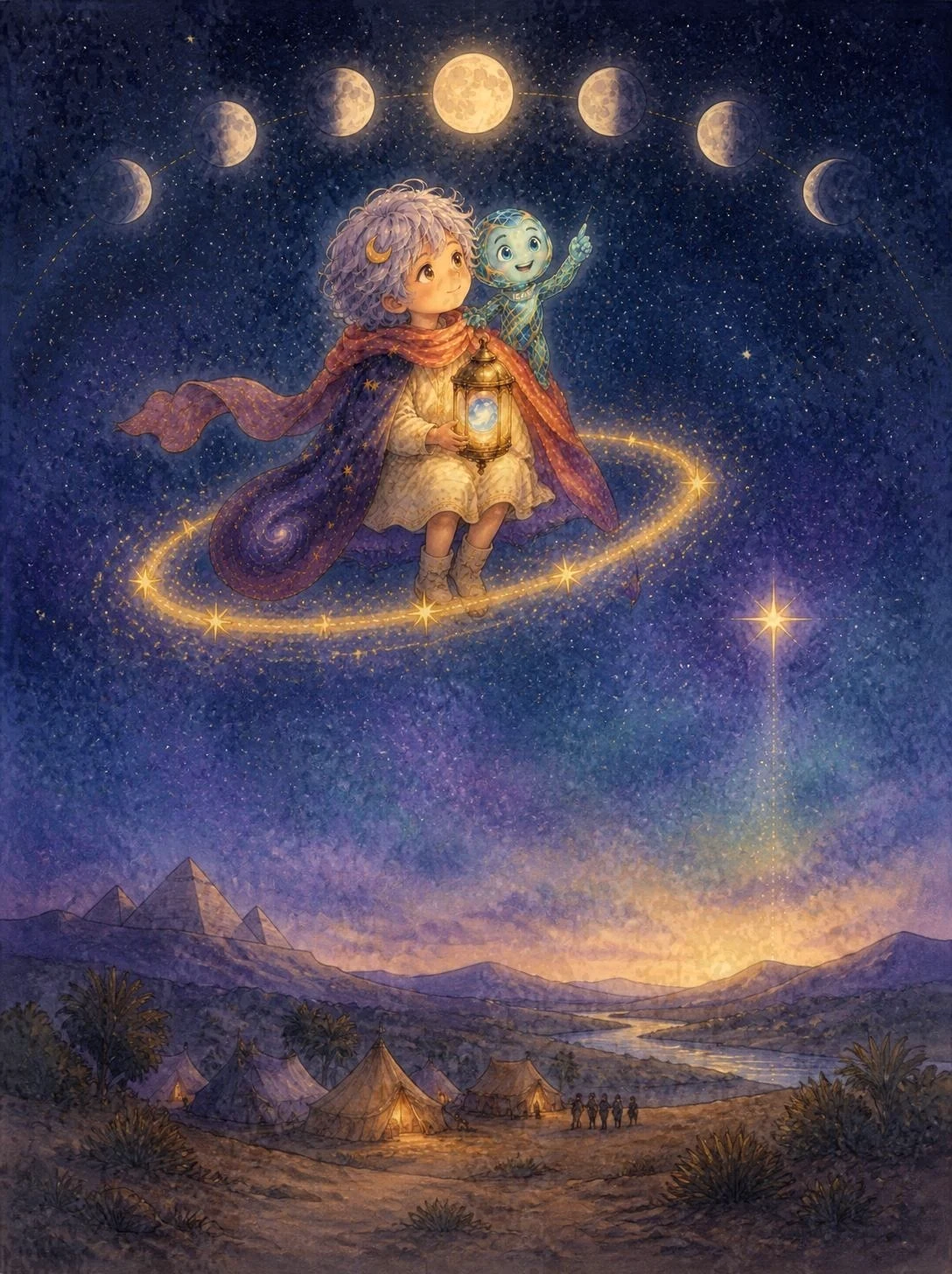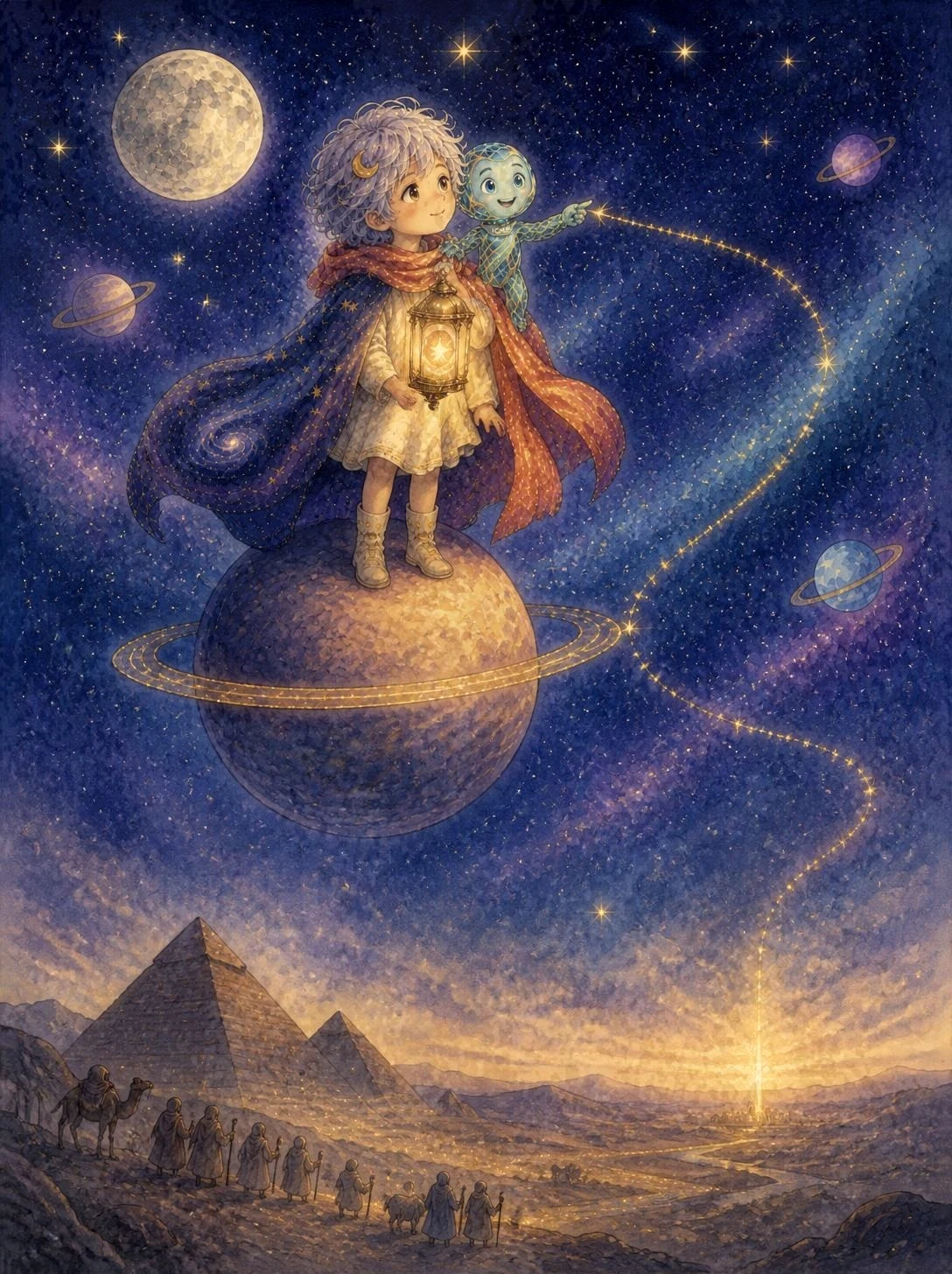
Path Star
One golden thread
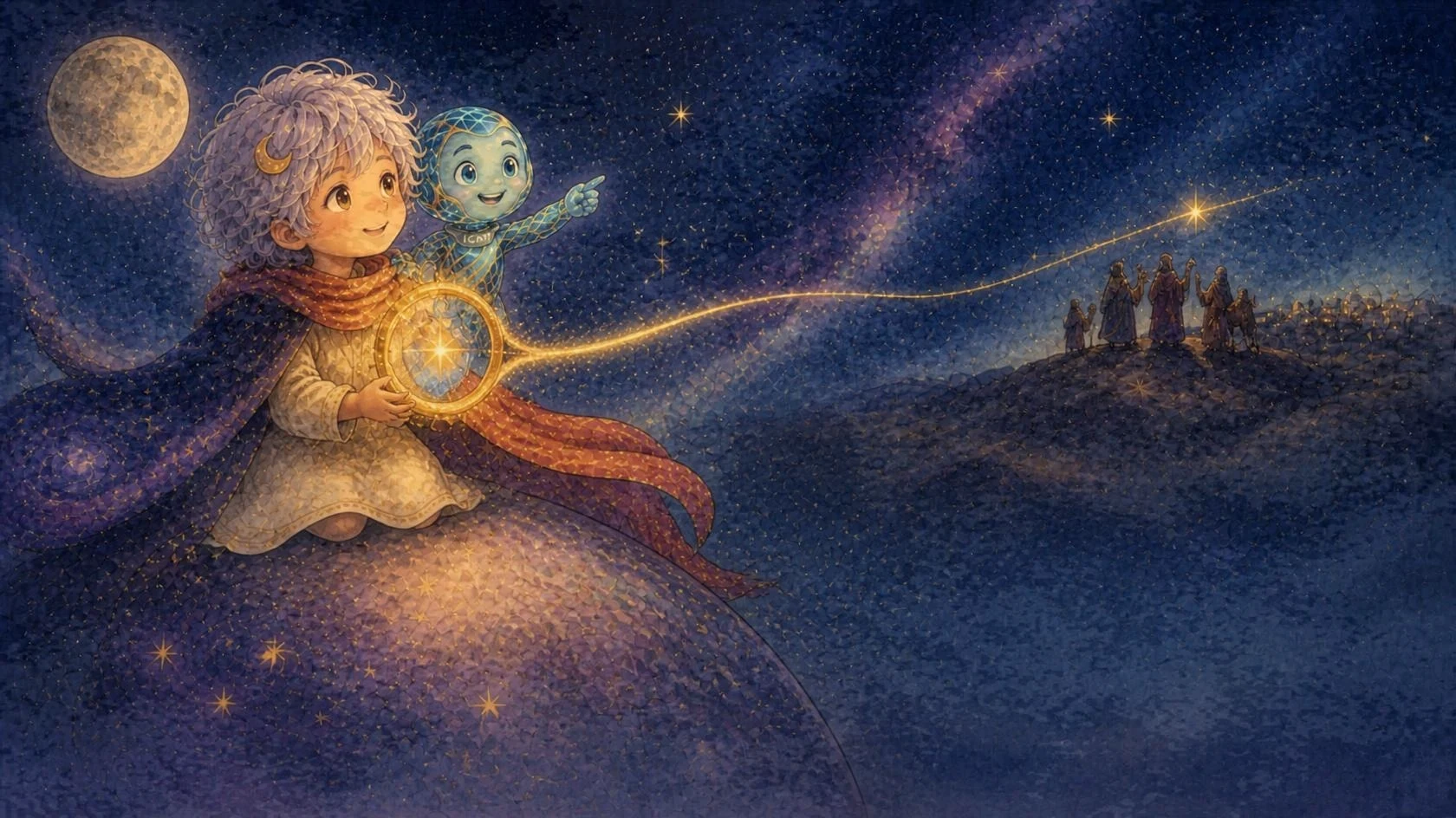
Nuri's star-ring trembled. Inside the ring a thin thread appeared and stretched far into the dark. "Komo, where does this thread go?" Komo traced it with one finger. "I don't know either. Let's follow it to the end. We only watch from far away." Then he added, "And let's count how many dark nights come." Nuri held her star lantern tight. "Path Star… who will walk, and where?"
A reed basket and a desert flame
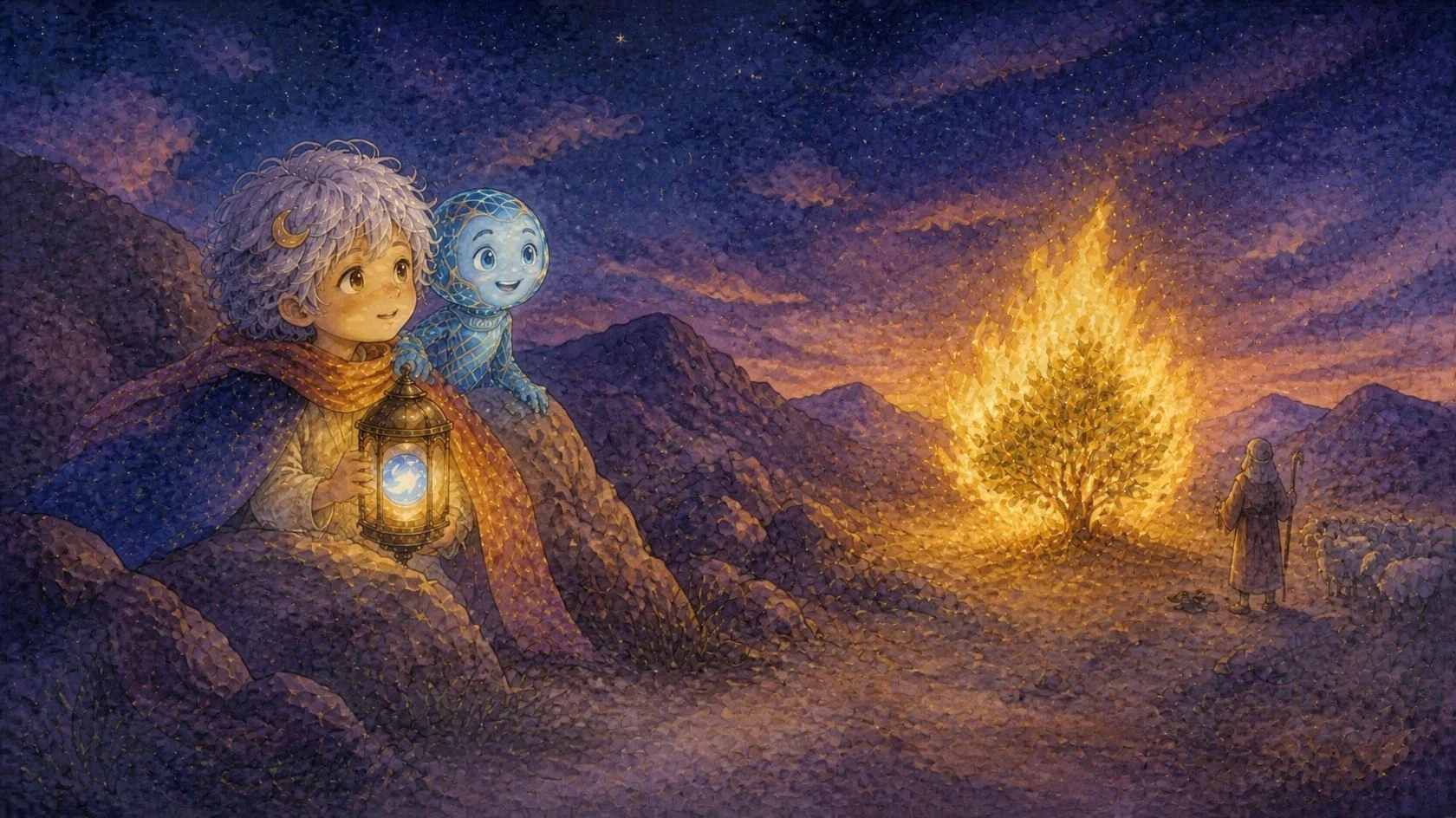
Past the ring blew a hot wind: Egypt. Pharaoh, the king of Egypt, was cruel to the people of Israel. Thump, thump went the bricks. The king even ordered that Israel's baby boys be taken away. A mother hid her baby three months, then laid him in a reed basket by the Nile. Pharaoh's daughter lifted him out. His name was Moses. Grown-up Moses kept sheep in the desert. One day a bush was wrapped in flames. The fire burned, but the bush did not burn up! Retold God called Moses: "Take off your sandals; this ground is holy. I have seen my people's pain. I am sending you to Pharaoh. Lead my people out."
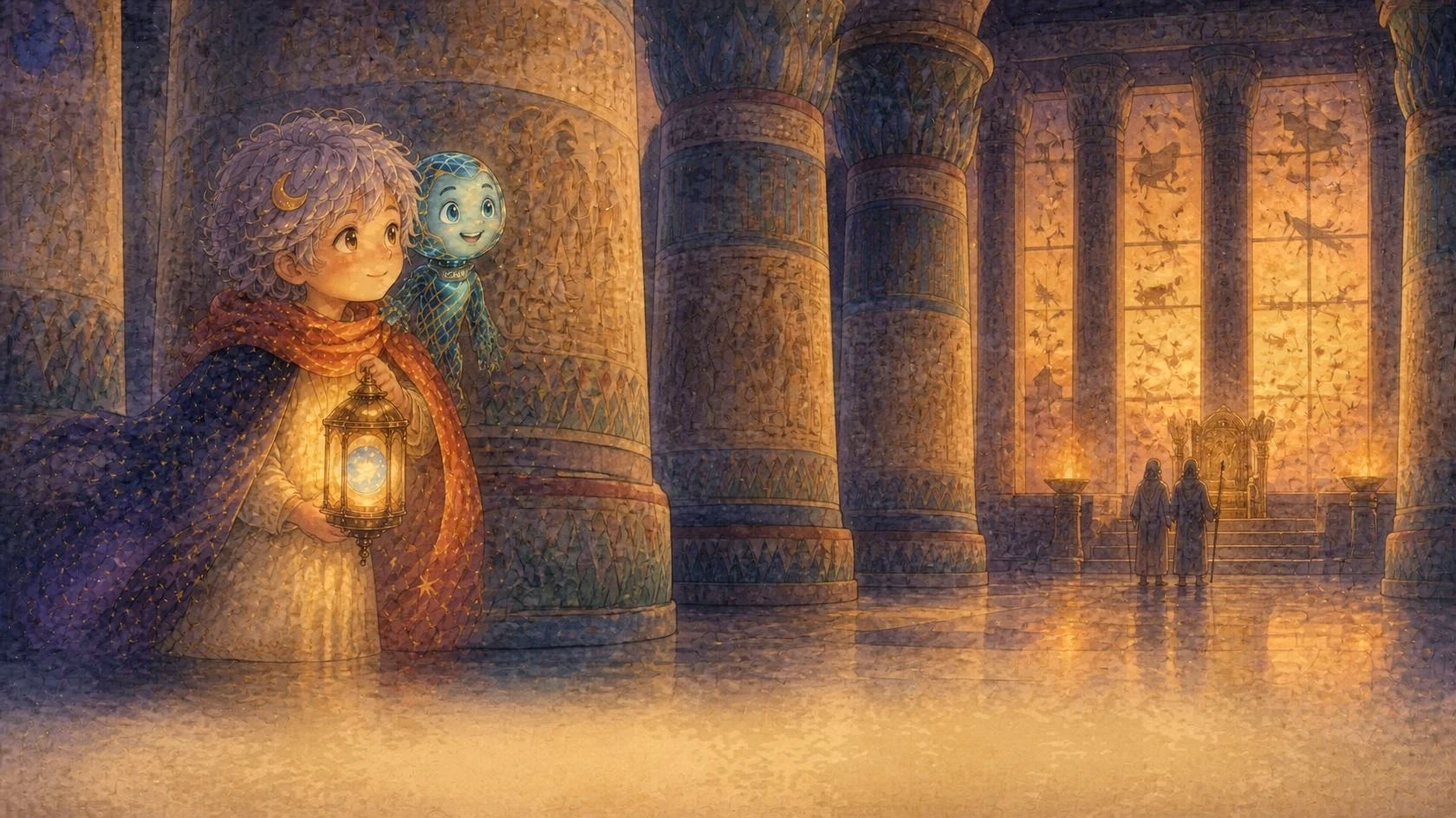
Again… again… again
Moses and his brother Aaron went into the palace with God's message. Retold "Let my people go." Retold Pharaoh sneered. "Who is the LORD? I will not let them go!" Then the river turned red. Pharaoh just turned and went into his palace. Frogs went hop! Even on the beds, hop! Pharaoh called Moses. Retold "Take the frogs away, and I will let them go." When the frogs were gone— Pharaoh made his heart hard and stubborn again. Hail came crashing! Retold "Make it stop, and I will let them go." When the hail stopped— again. Locusts darkened the sky. When the locusts flew away— again. Komo folded down one finger at a time. "Again… again… again."
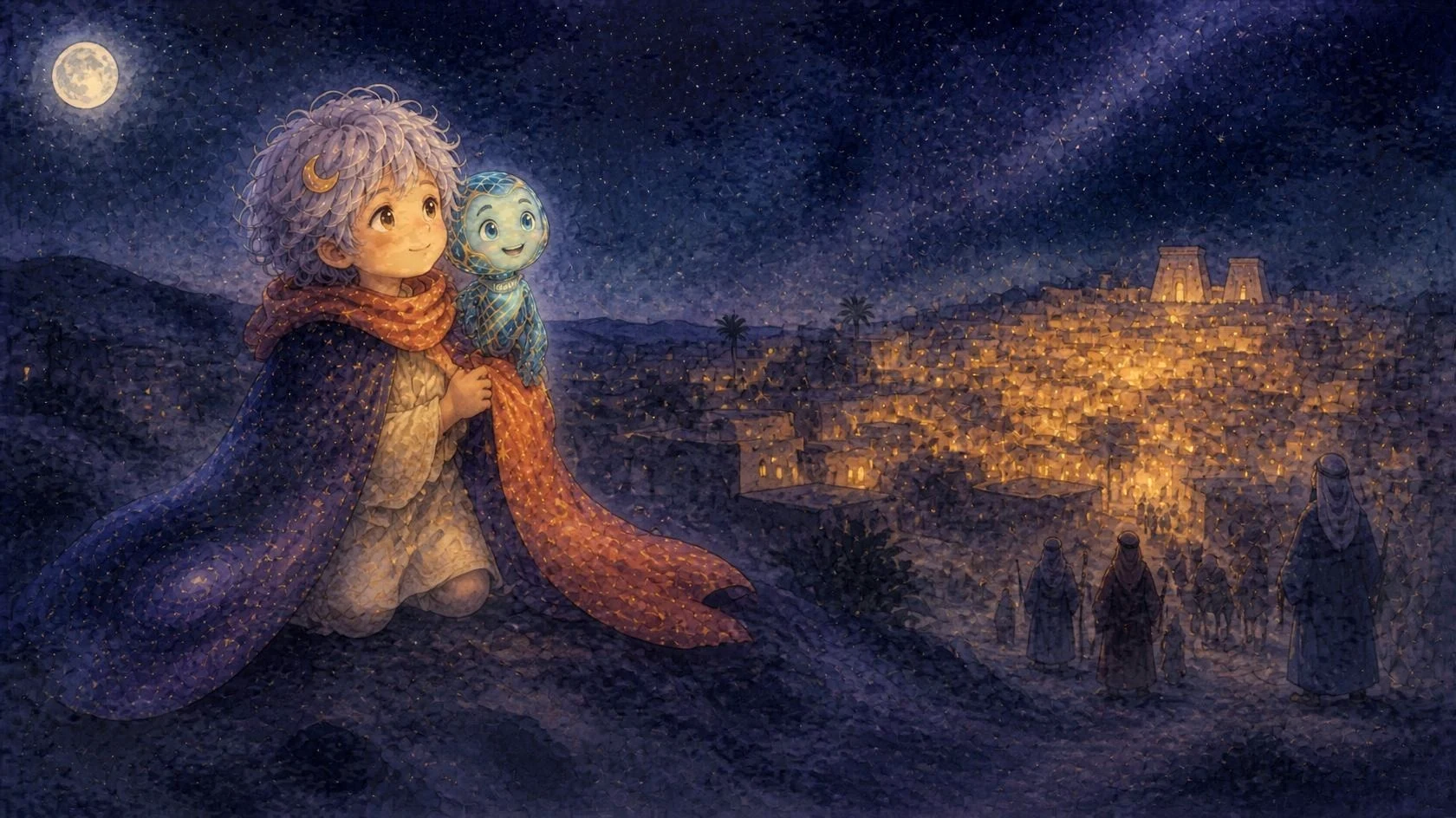
So dark you cannot see your hand
Moses stretched his hand toward the sky, and thick darkness covered all of Egypt. Nuri hid her star lantern under her cape. "Our light must not step into this story." But where the people of Israel lived— every home had light. It was not Nuri's lantern. Komo held up one finger. "One."
Even in the dark night, the light was right there.
After three days Pharaoh said, Retold "Go. But leave your sheep and cattle!" Then he changed his mind again. "Get away from me! Never see my face again!"
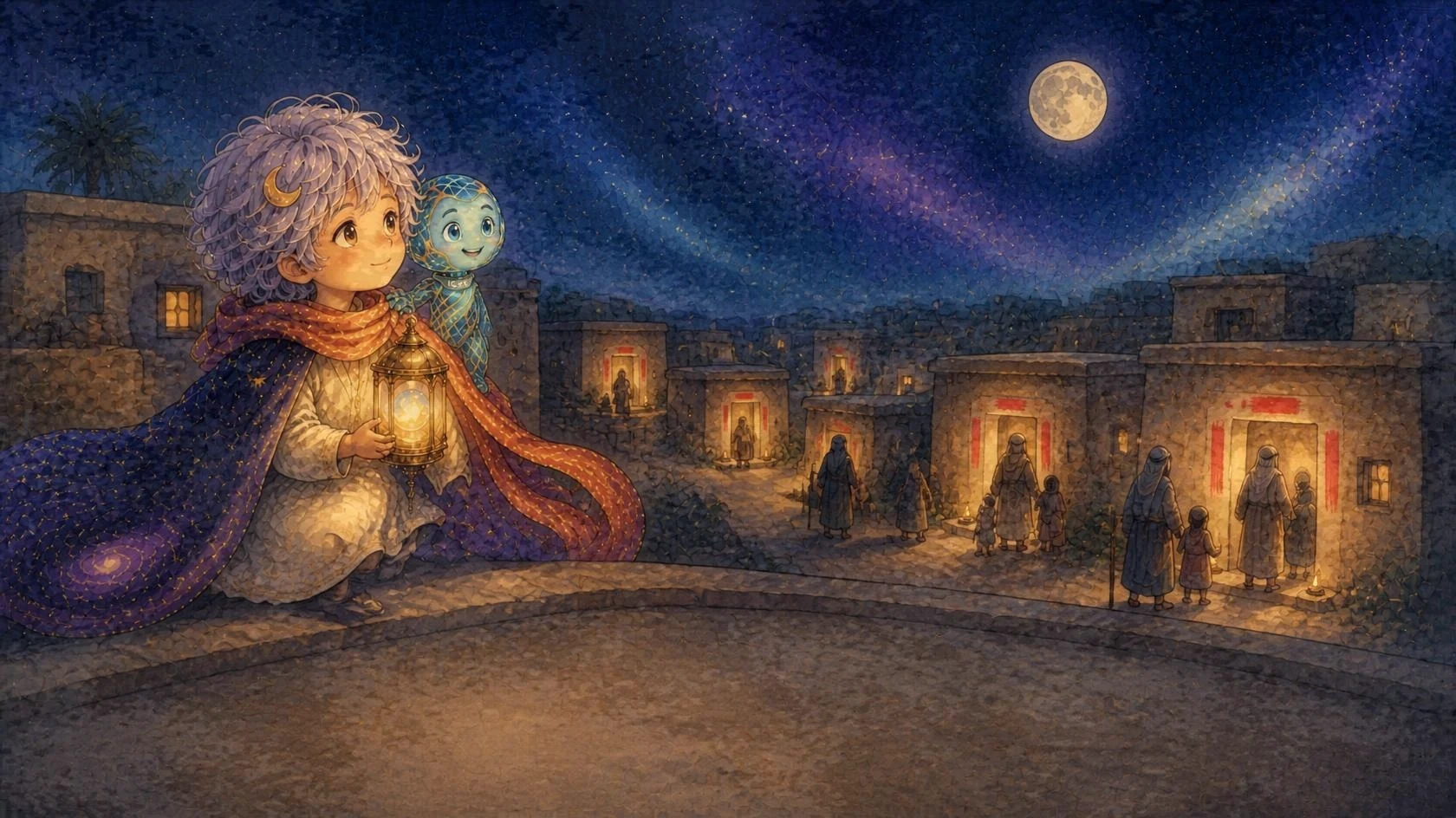
A red mark on the doorposts
Retold God told Moses, "There is one more plague. After that, Pharaoh will send you out. This month will be the first month of your year." Here was God's sign of promise: on the fourteenth evening of the first month, each family took a lamb and put its blood on the doorposts and over the door. They ate with belts tied, sandals on, staffs in hand, like people about to leave. This night is called Passover.
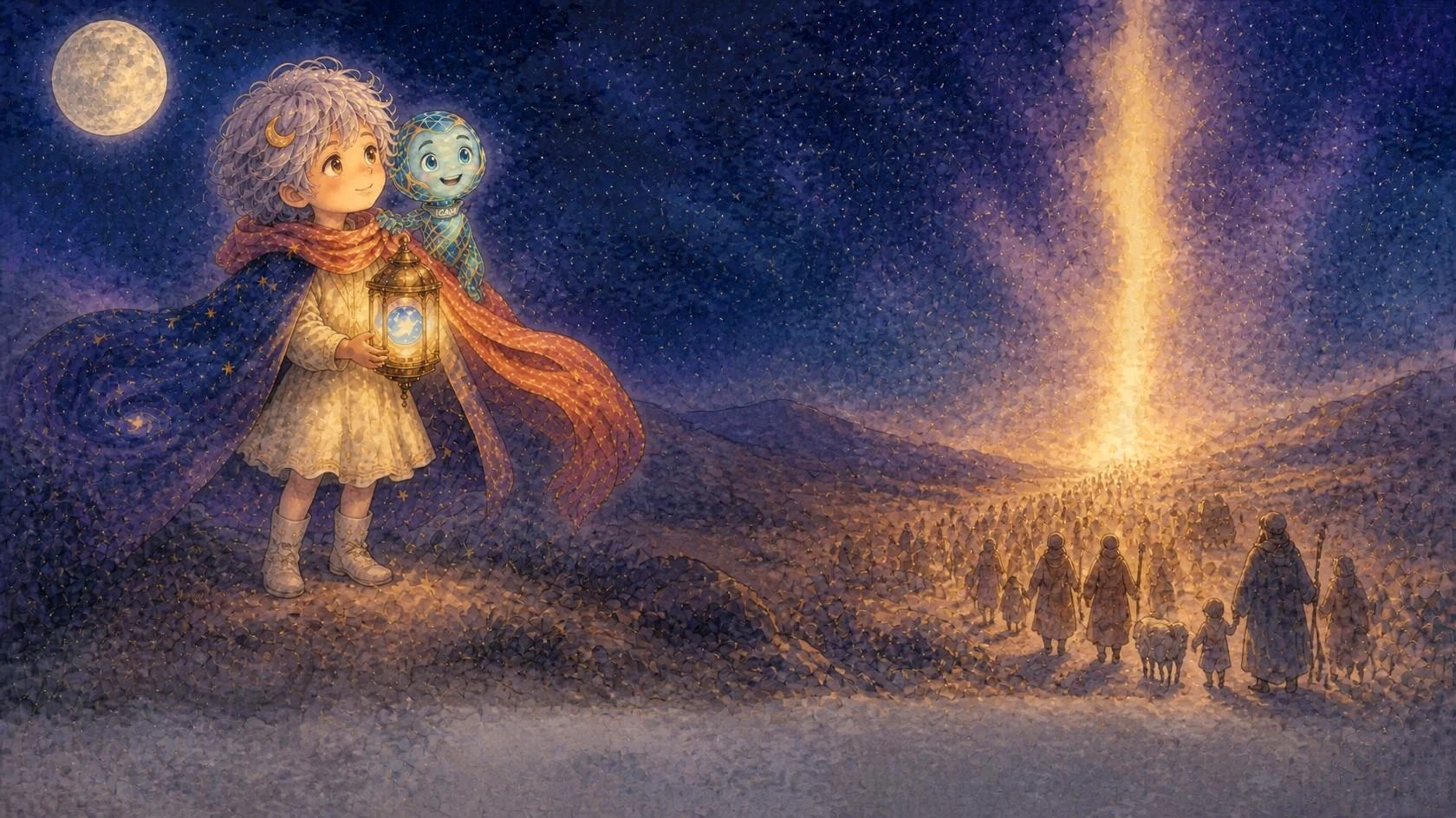
Footsteps all through the night
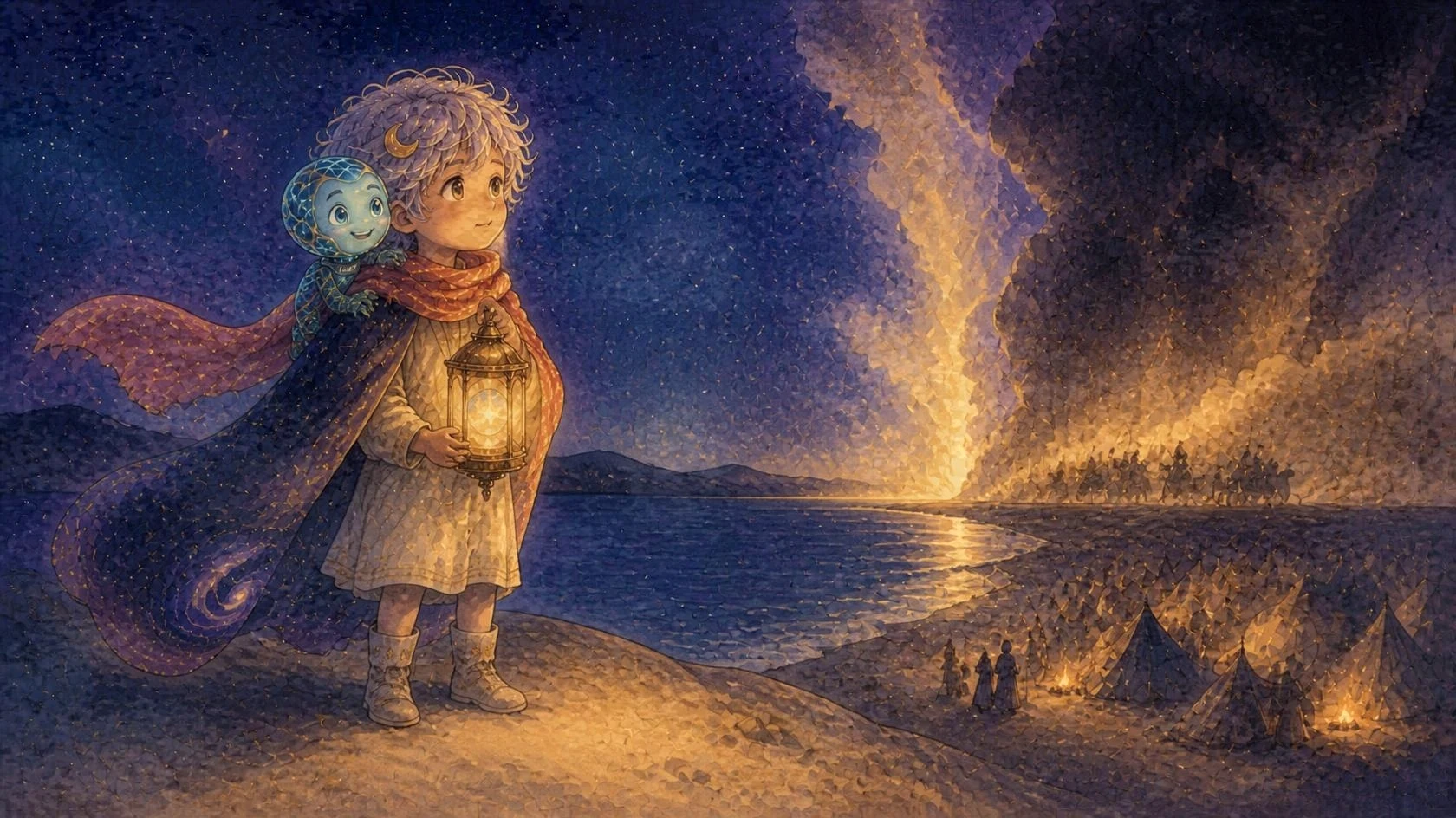
At midnight the last plague came on Egypt. In Egyptian homes the oldest sons died. A sad thing came even to Pharaoh's palace. Nuri held her lantern close and listened a long time to the crying across the land. That night Retold Pharaoh said, "Get up and go! Worship the LORD as you said." The people of Israel set out— mothers carrying babies, children herding sheep. It was a dark road they had never walked. By day a pillar of cloud, and by night a pillar of fire, went ahead and lit the way. Nuri's golden thread stretched that way too. Komo held up two fingers.
Even in the dark night, the light was right there.
The ground began to rumble
The people set up tents by the sea. At last they could rest. But then— the ground began to rumble. Dust rose far away. Pharaoh's chariots! He had changed his mind again. Remember the pattern on page 3? The wide sea ahead, hoofbeats behind. The people cried out. Moses said, "Don't be afraid. Stand still, and see the salvation of Yahweh, which he will work for you today." Then the pillar of cloud moved behind the people, between the two camps. On Egypt's side were cloud and darkness; on Israel's side the night was bright. Komo held up three fingers.
Even in the dark night, the light was right there.
Whoooosh, all night long
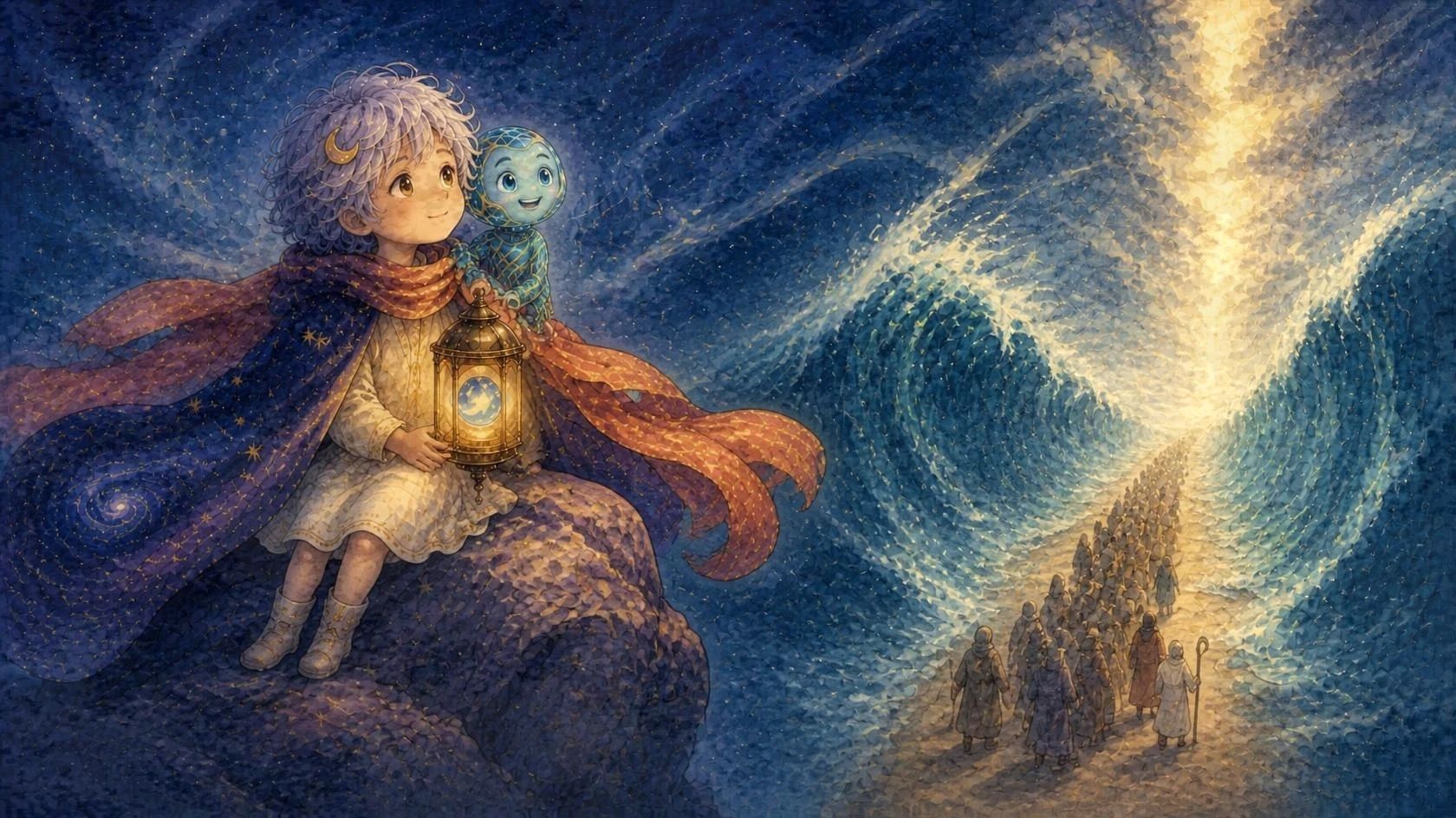
Moses stretched his hand over the sea. Whoooosh— a strong east wind blew all night. The water split, and dry ground appeared in the middle of the sea. The people of Israel walked across between walls of water. Crunch, crunch went the sand; splash, splash went the walls. At dawn the water came back to its place. Pharaoh's army, which had followed into the sea, could not get out. The sea grew quiet again. For a long time Nuri could not say a word. When morning came, the people stood by the shore. They feared the LORD, and they believed him.
Boom, boom, the hand drum
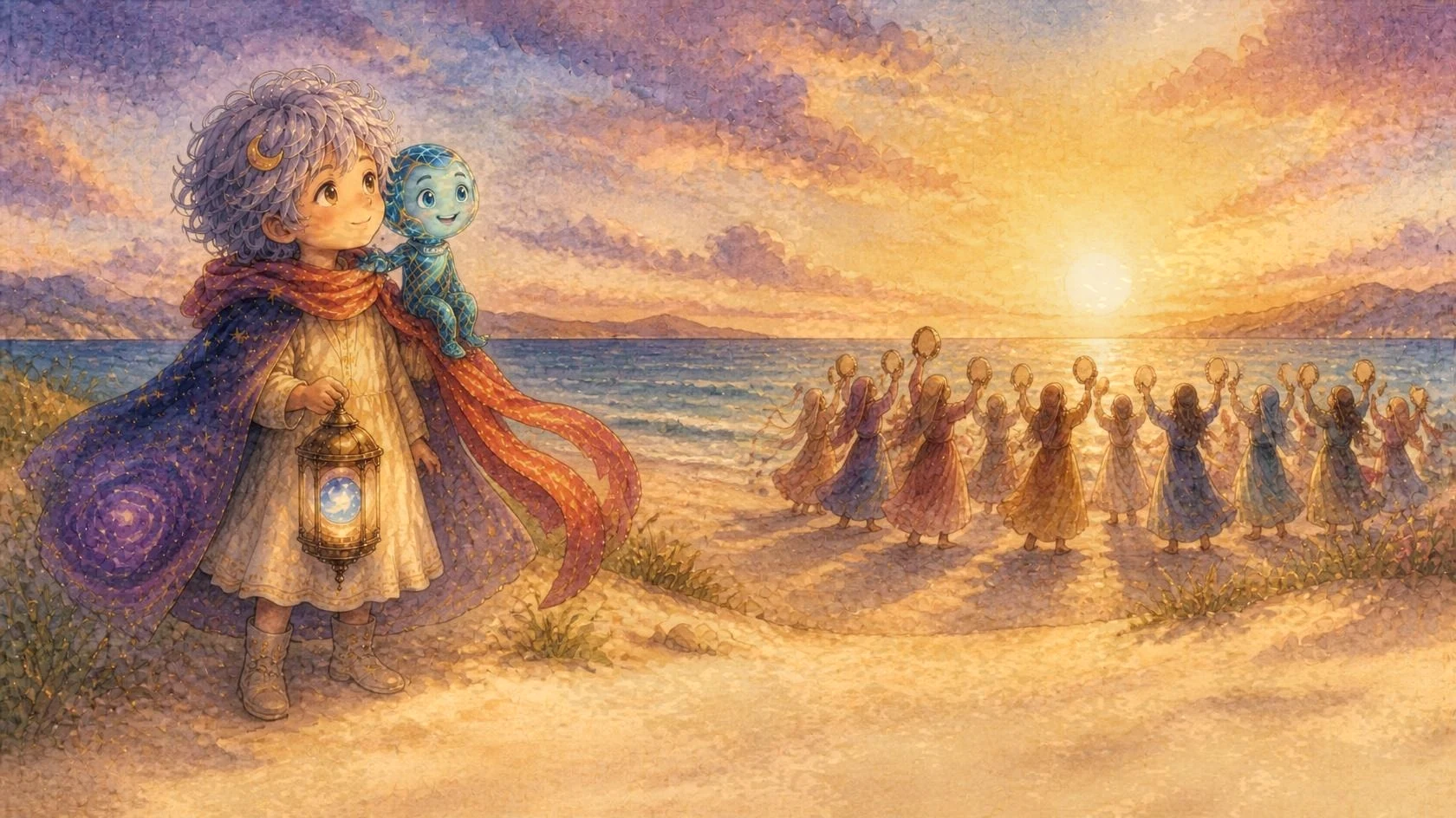
Now the story became everyone's song. Retold Moses and the people sang, "I will sing to the LORD! God is high and great! The LORD is my strength, my song, my salvation!" Miriam, Aaron's sister, picked up a hand drum. Boom, boom, boom. The women followed her, dancing. Retold Miriam sang back, "Everyone, sing to the LORD! God is high and great!" Komo whispered, "One person sings, and others sing it back. That's how a song repeats."
First words at the mountain
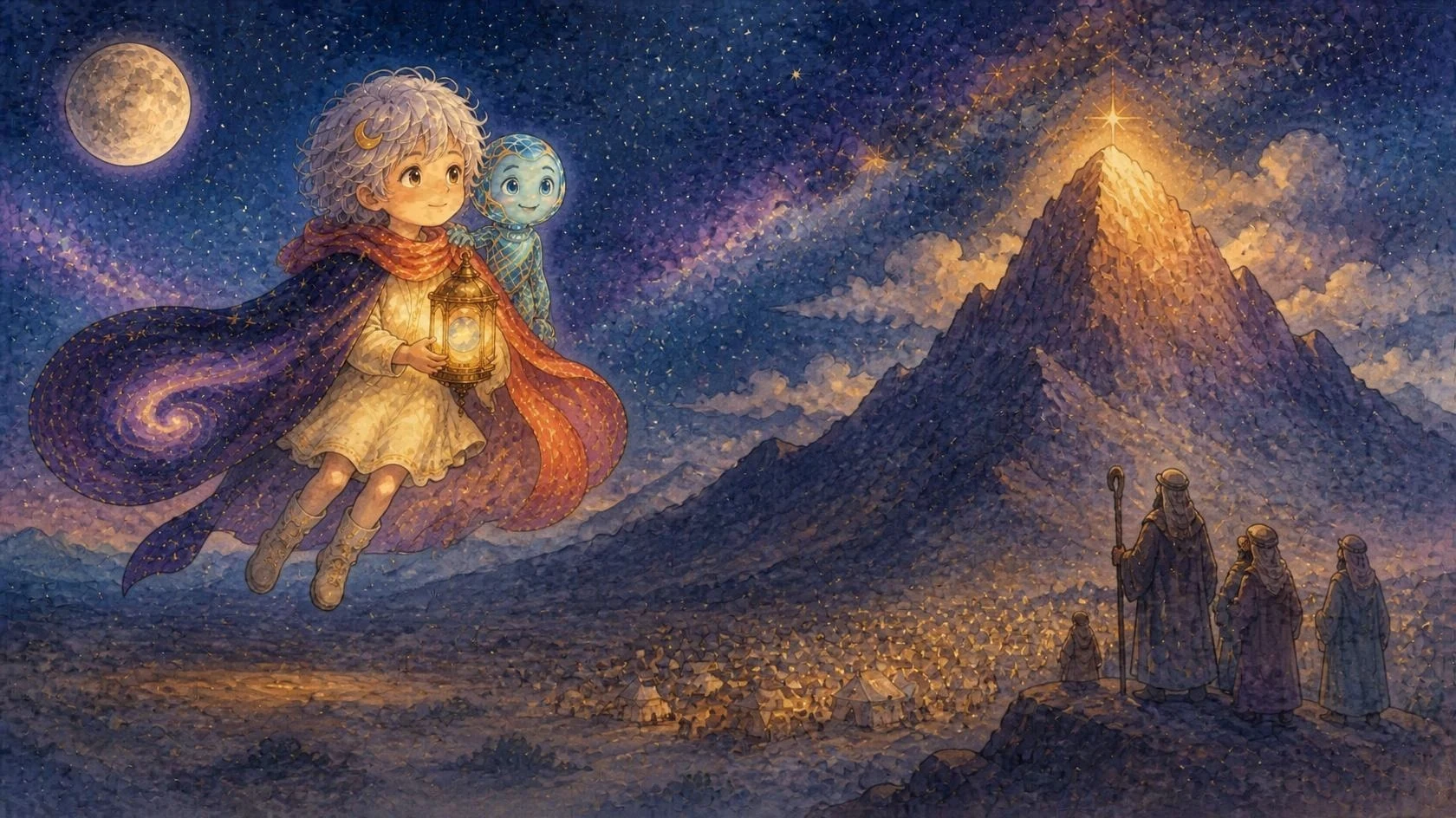
Three months after leaving Egypt, the people reached Mount Sinai. Thunder, lightning, smoke, a long trumpet blast. God gave ten words for living together. Words like these are called "law." But the very first words were not a rule. First God reminded them how he had rescued them. Then he showed the way to live together. Retold "Have no other gods but me." "Honor your parents." "Do not murder." "Do not steal." "Do not tell lies about your neighbor." Komo whispered, "Short and clear, right? 'Do' and 'Do not.' That's how promise words look."
There was a light that lit the road even at night. Now that light was lighting the way to live together too.
The sun is still there at night
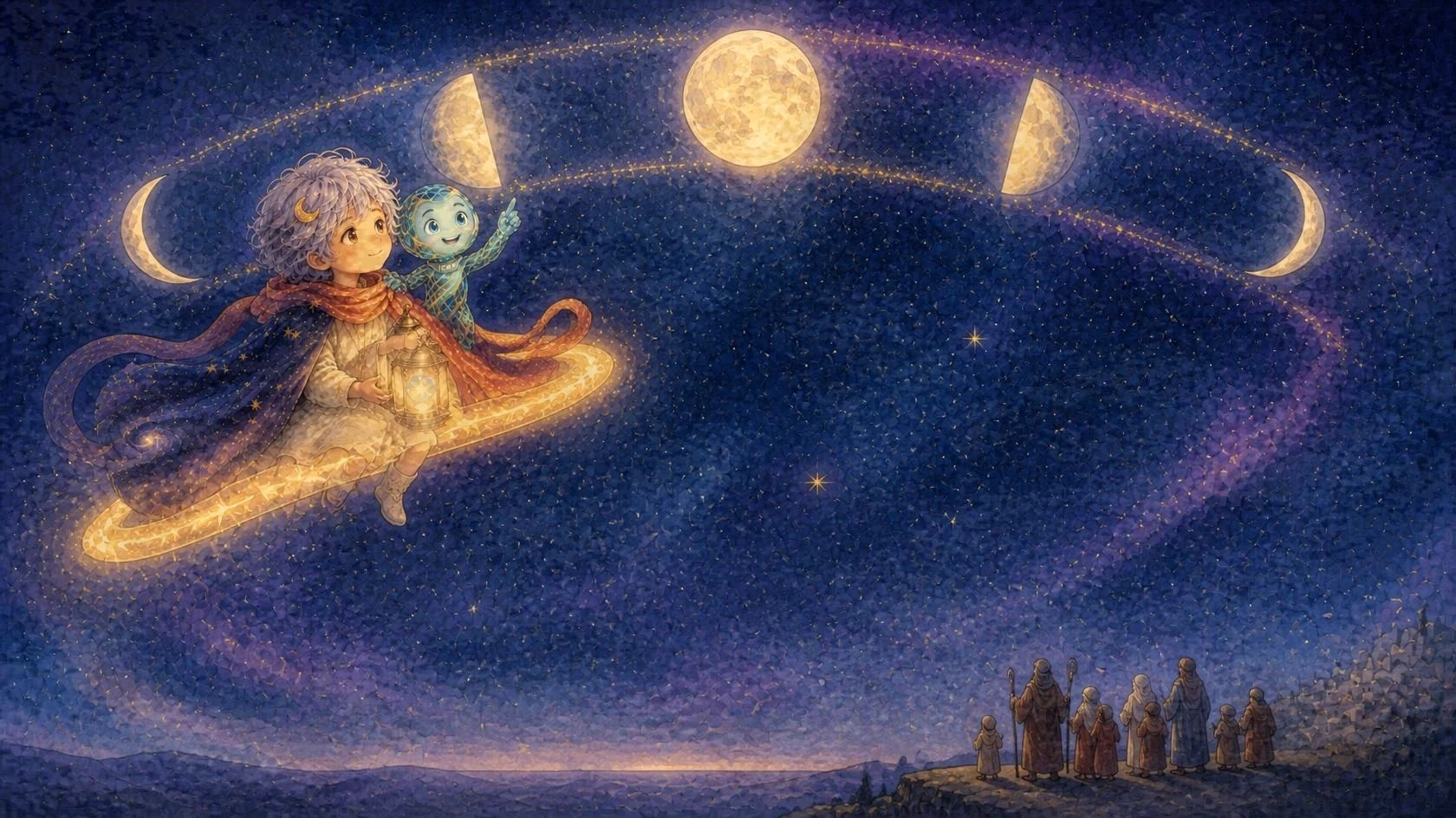
On the way home, Komo pointed at the round moon. "The moon looks different each day. Thin, then full, then thin again. One round takes about 29 and a half days." "So people long ago counted days by the moon!" Nuri asked, "How does the moon shine at night?" "It reflects sunlight. Even when our side is dark, the sun is shining on the other side of the Earth." "Wow… even at night, the sun is still right there."
- The moon looks different about every 29.5 days. It doesn't change shape—we see a different part of its sunlit side
- Ancient Israel counted months by the moon; today's Jewish calendar is still based on its cycle
On my night road too
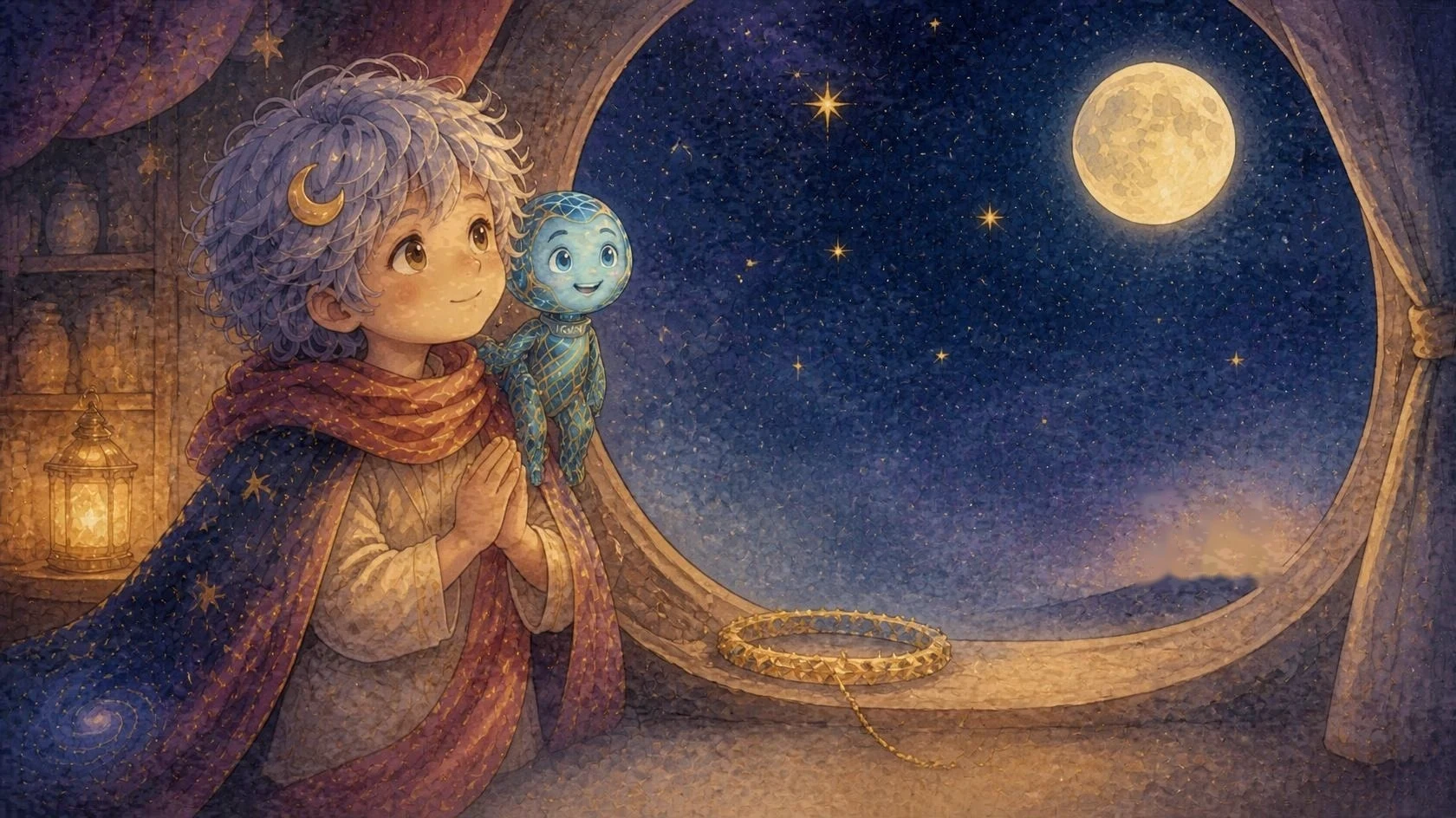
Back home, Nuri set the star-ring by the window. The golden thread glowed quietly now. Komo asked, "The three nights—do you remember?" Nuri looked out the window and nodded. Then she folded her hands. "God, I have scary, dark nights too. Then, please light the way in front of me. Help me never forget how you rescue." Nuri asked, "Komo, where next?" Komo smiled. "Next is Wilderness Star. What rhythm will the walking days have?"
Eight path cards
Tap a card to flip it. Put them in order and retell the story from the pictures.
Four thinking games
- 1[Class] Comprehension · Put the eight path cards in order and tell each one in your own words.
- 2[Home] Analysis · How many times do you hear the refrain "Even in the dark night, the light was right there"? Put a pebble for each. How was the light leading ahead different from guarding behind?
- 3[Home] Inference · On Passover night, why did people eat with sandals on and staffs in hand?
- 4[Class] Prediction · Look at the back cover. In Wilderness Star, what will the people in the tents meet? The moon and the new star are clues.
Hear the first answer first; only when needed ask, "Which scene made you think that?" [Home] Flashlight game: flashlight (sun), ball (moon), your head (Earth)—show that the sun stays on even when our side is night.
Which night do you want to remember longest?
20-minute lesson flow
- Prep
- 3 pebbles (refrain count), 8 path cards, flashlight & ball, optional hand drum.
- 0–1 min open
- "Where does the thread on the cover lead?" Note Komo's plan to count the dark nights.
- 1–9 min pp.2–4
- p.2 → p.3 analysis (pattern) → p.4 prediction. Prediction means giving reasons, not guessing right. Check on p.6 (sent) and p.7 (changed again).
- 9–14 min pp.5–8
- p.5 comprehension → p.6 midnight: lower your voice, no question → pp.7–8 sea. Pause 3 sec at "grew quiet."
- 14–16 min pp.9–10
- p.9 call-and-response: teacher sings Moses' line, children Miriam's (clap boom·boom·boom) → inference → p.10 law.
- 16–20 min
- p.11 flashlight 30 sec (science is a window of wonder, not proof) → p.12 prayer → order the path cards.
- 20 min is a target
- Time it in the first class with children's answers. If long, handle p.11 box and p.12 reading separately; keep all 4 pauses.
- Genre
- Story (ch.1–14, events in order) · Song (ch.15, one sings, others answer) · Law (ch.20, short "do / do not"; rescue comes first).
- Words
- Pharaoh = king of Egypt · stubborn = refusing to change · doorpost = post beside a door · Passover = the night God passed over · chariot = horse-drawn war cart · hand drum
Observation and hard questions
- Observe
- Sprout: "He won't let them go." · Stem: "He changed his mind after it stopped before, so he will again." · Fruit: "He may let them go, but the pattern says he might chase them" (pp.3→4→7).
- Answer keys
- Refrain 3×: p.4 lit homes (light that sets apart) · p.6 pillar (light ahead) · p.7 bright night (light guarding behind). p.3: frogs, hail, locusts—"stop it, I'll let them go" → hard again; at the blood plague he didn't even call Moses (7:23)—spotting this = fruit. p.4: any answer with a reason from p.3 or 10:24–28. Actually: sent (12:31), then chased (14:5). p.5: lamb, blood, belt, sandals, staff, eating quickly. p.9: joy, relief, fear and faith (14:31)—clues "strength, salvation," drum.
- By age (p.4)
- 5–6: "He said 'Go!' then 'No!'—what now?" · 7–8: "How many times did he change? So this time?" · 9–10: "Predict, then compare with p.7."
- "Why the Egyptian children?"
- The Bible doesn't hide that night's crying (12:30). God warned ahead (11:4–7), and some Egyptians feared his word and took shelter (9:20). "I don't know everything either. Feeling sad about it is a good heart." Don't invent reasons.
- "What about the soldiers?"
- The Bible says it briefly (14:28). We keep it brief and far away. "Yes, it's a scary scene."
- "Who hardened Pharaoh?" · "Was it an eclipse?"
- Both are in the text: he hardened himself (8:15), God hardened him (9:12). We don't explain the dark or the sea as nature or proof.
- Not covered · notes
- Staff & snake, each plague, manna, golden calf, tabernacle. Boxes and the unmarked quote (14:13) = WEB; Retold = easy words. Miriam = "Aaron's sister" (15:20; Num 26:59). Theology/science review and a timed read-aloud before publishing are advised.
아이캔 코모는 미래를 커젤로 바라보나 원더로 간구합니다.