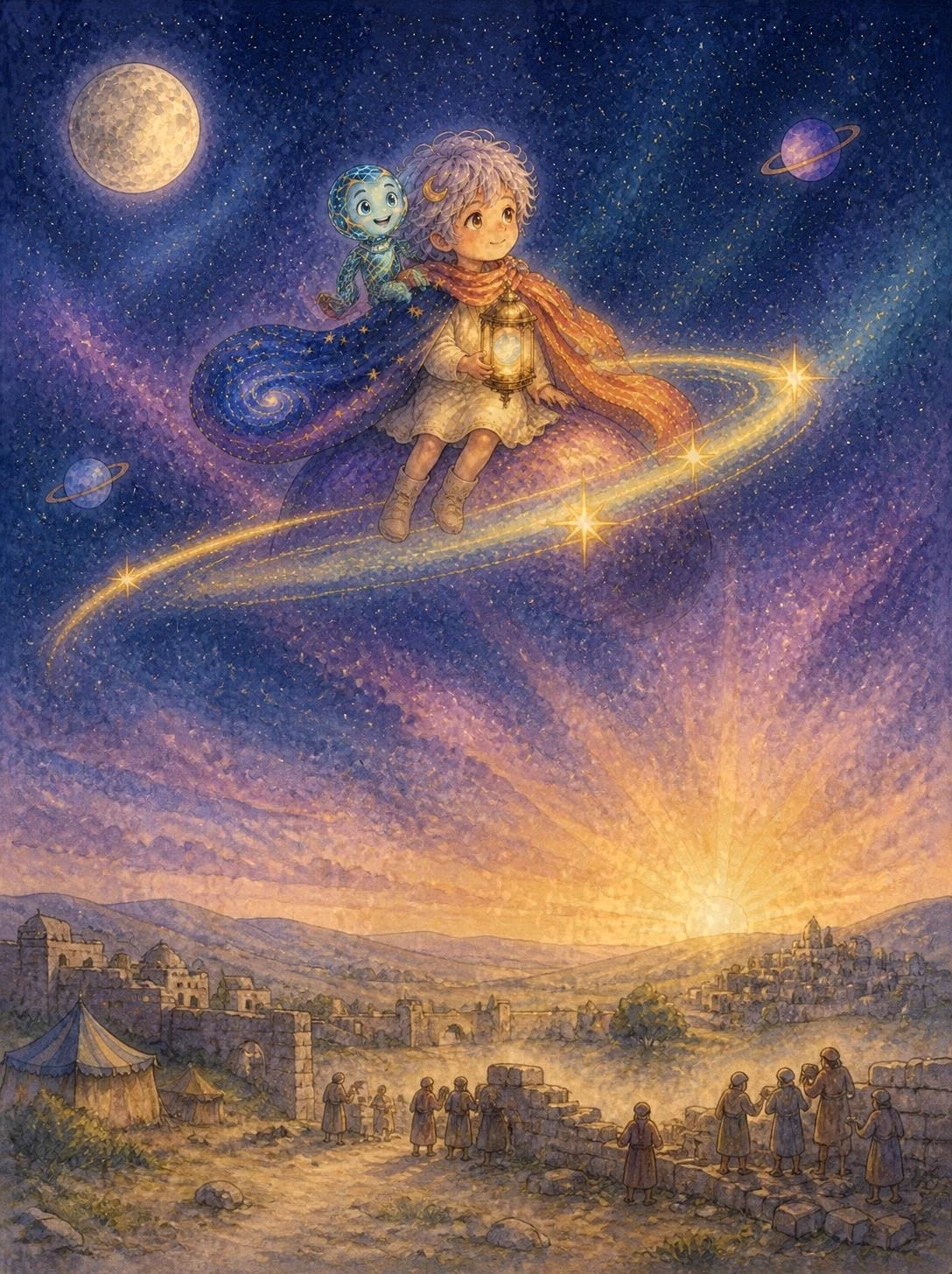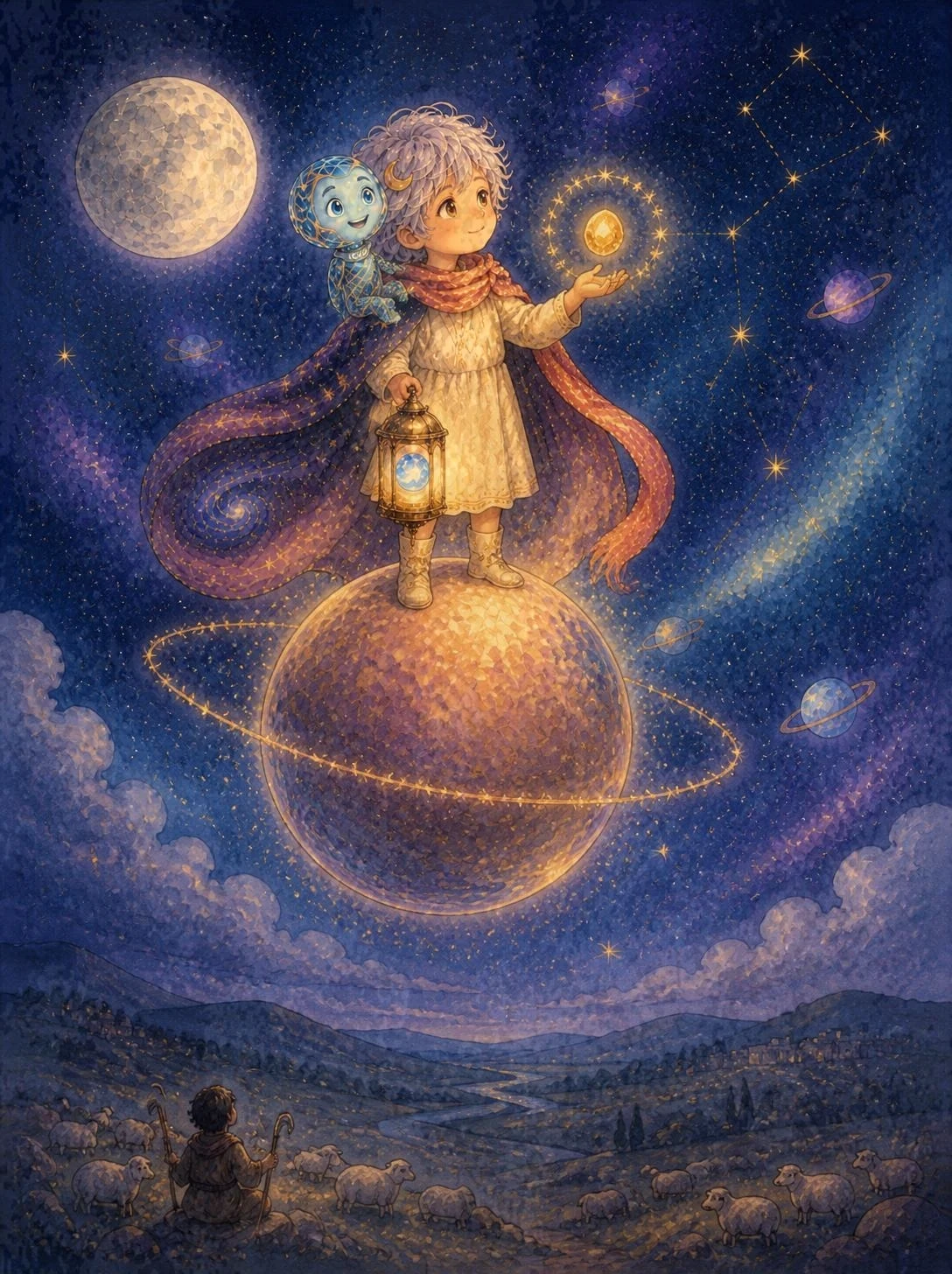
Shepherd Star

A song in the ring
Nuri's star-ring made a sound. Ting— tring. A clear sound, like a plucked string. Then, far away, baa— a little lamb. In the middle of the ring, a golden pebble showed, smaller than a fingernail and very smooth. "Komo, what is that?" Komo, on her shoulder, squinted. "I don't know. I think we're going to the fields. This ring is a window into old stories. It doesn't grant wishes." Komo raised one finger. "We only watch from far away."
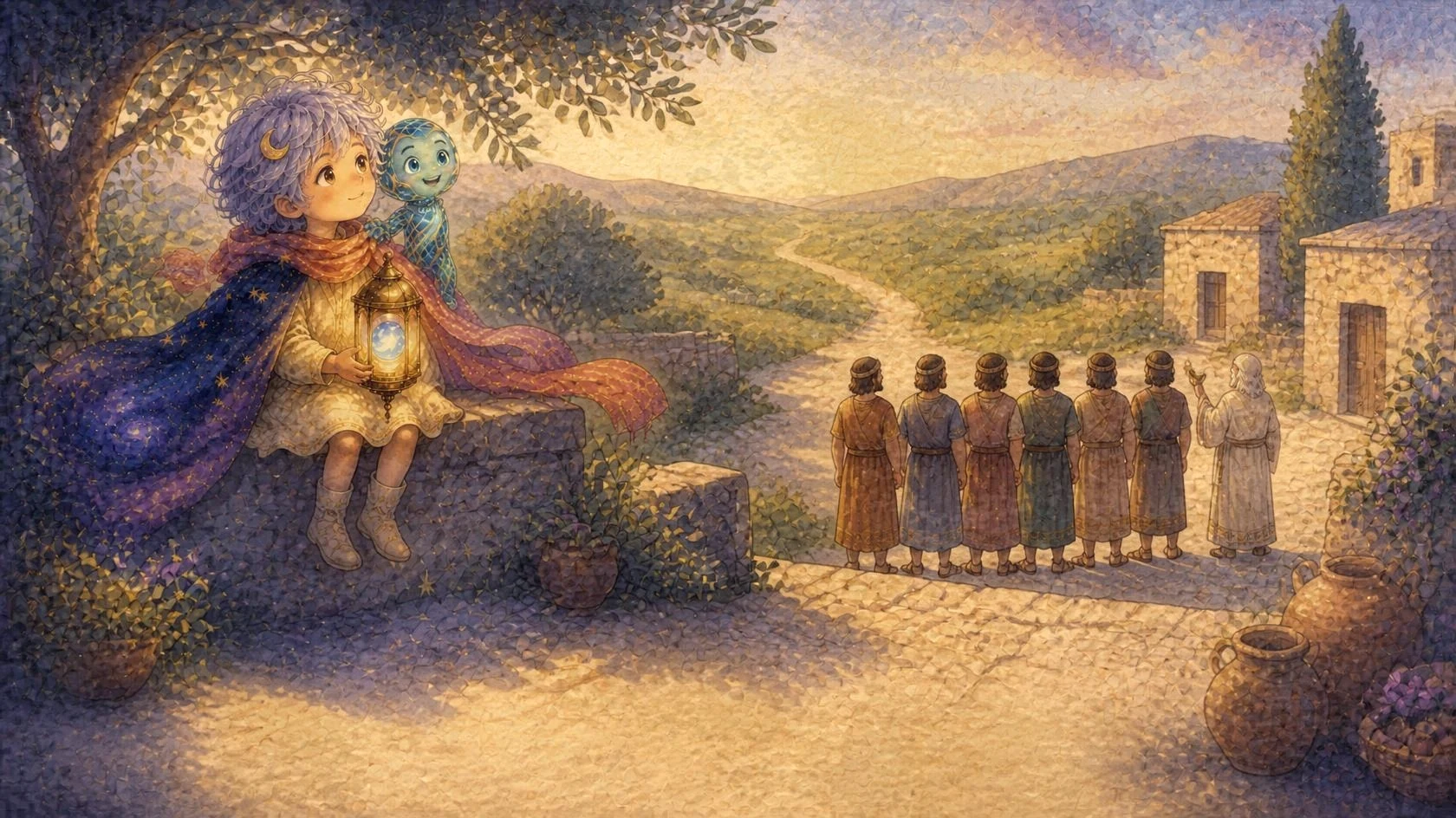
Are these all your sons?
The old prophet Samuel came to Jesse's house in Bethlehem. God had chosen one of Jesse's sons to be king. The oldest, Eliab, was tall and handsome. Samuel thought, Retold "This must be the one!" But God said, Retold "Don't look at his height or his face. I don't see the way people see." The second son, the third… all seven sons passed by. Samuel asked Jesse, Retold "Are these all your sons?" Jesse answered, Retold "There is still the youngest. He is keeping the sheep." Samuel would not sit down until the boy came.
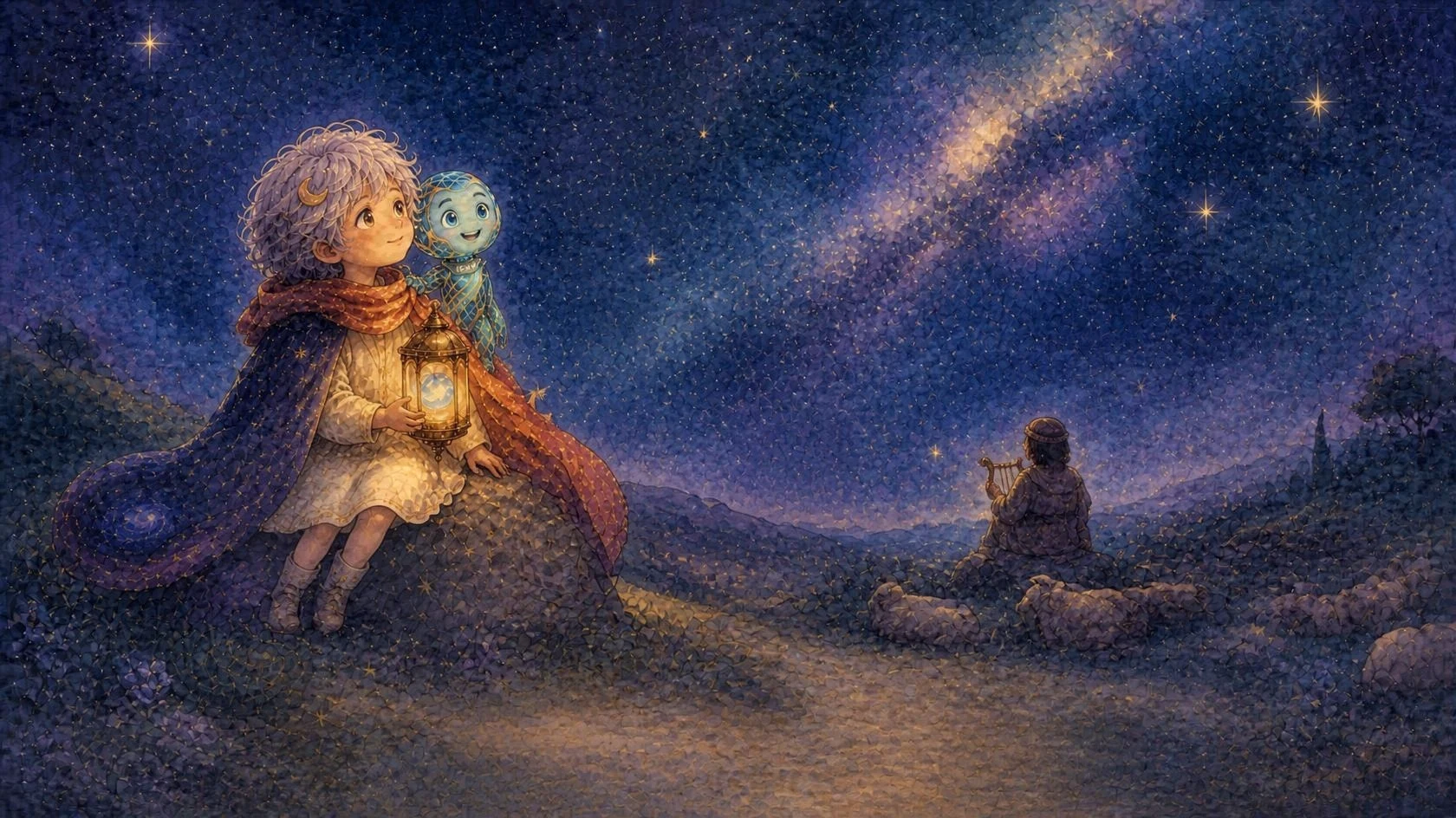
The shepherd's night sky
The boy who came running, out of breath, was David, the youngest. God said to Samuel, "Arise! Anoint him, for this is he." Samuel poured oil on David's head. It was not because David was better than everyone. God chose the little youngest by grace. David went back to keep the sheep. At night there seemed to be more stars than anyone could count. Later David wrote a song: "What is man, that you think of him? What is the son of man, that you care for him?" Komo sang softly,
The One bigger than the sky cares for little me.
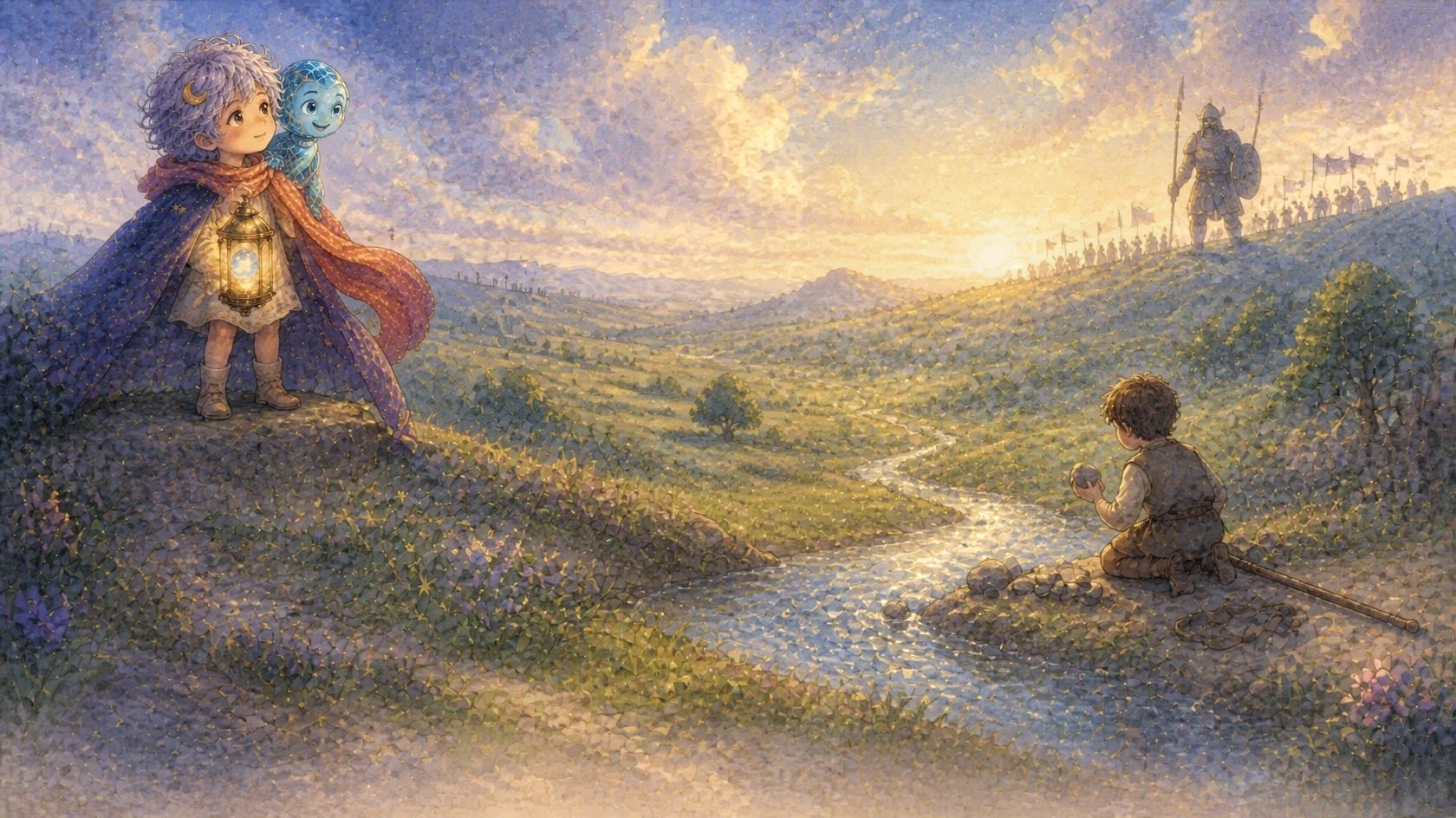
Five smooth stones
Years later, the Philistine army came. Across the valley, the giant Goliath shouted every day, Retold "Who will fight me?" Boom, boom— the ground shook as he walked. All of Israel's soldiers trembled. David came with food for his brothers and said to King Saul, Retold "I will go. When a lion or a bear took a lamb, I chased it and saved the lamb. I know who was with me then." David took off the heavy armor and chose five smooth stones from the stream. Komo gulped.
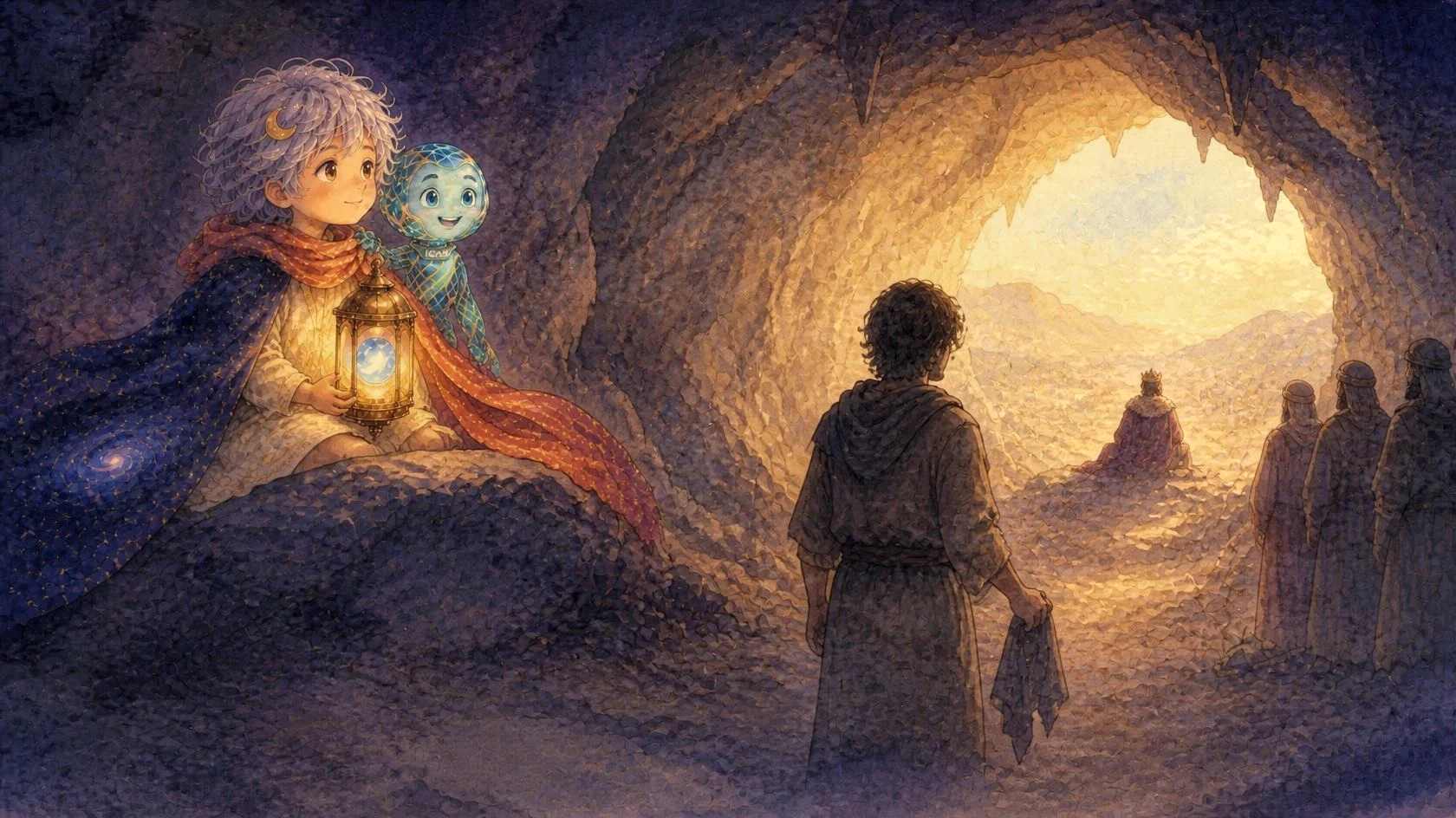
A corner of a robe
David called out to Goliath, "The battle is Yahweh's." Whoosh— one stone flew, and Goliath fell and died. It was a sad day on a battlefield long ago. Later King Saul grew very jealous of David and tried to harm him. David and his men hid deep in a desert cave. One day, Saul came into that very cave alone! The men whispered, Retold "Now's your chance!" David crept up… and cut off only a corner of Saul's robe. Even that made David's heart hurt. Retold "I will not harm the king God anointed." Seeing the corner of his robe, Saul wept: "You are more righteous than I."
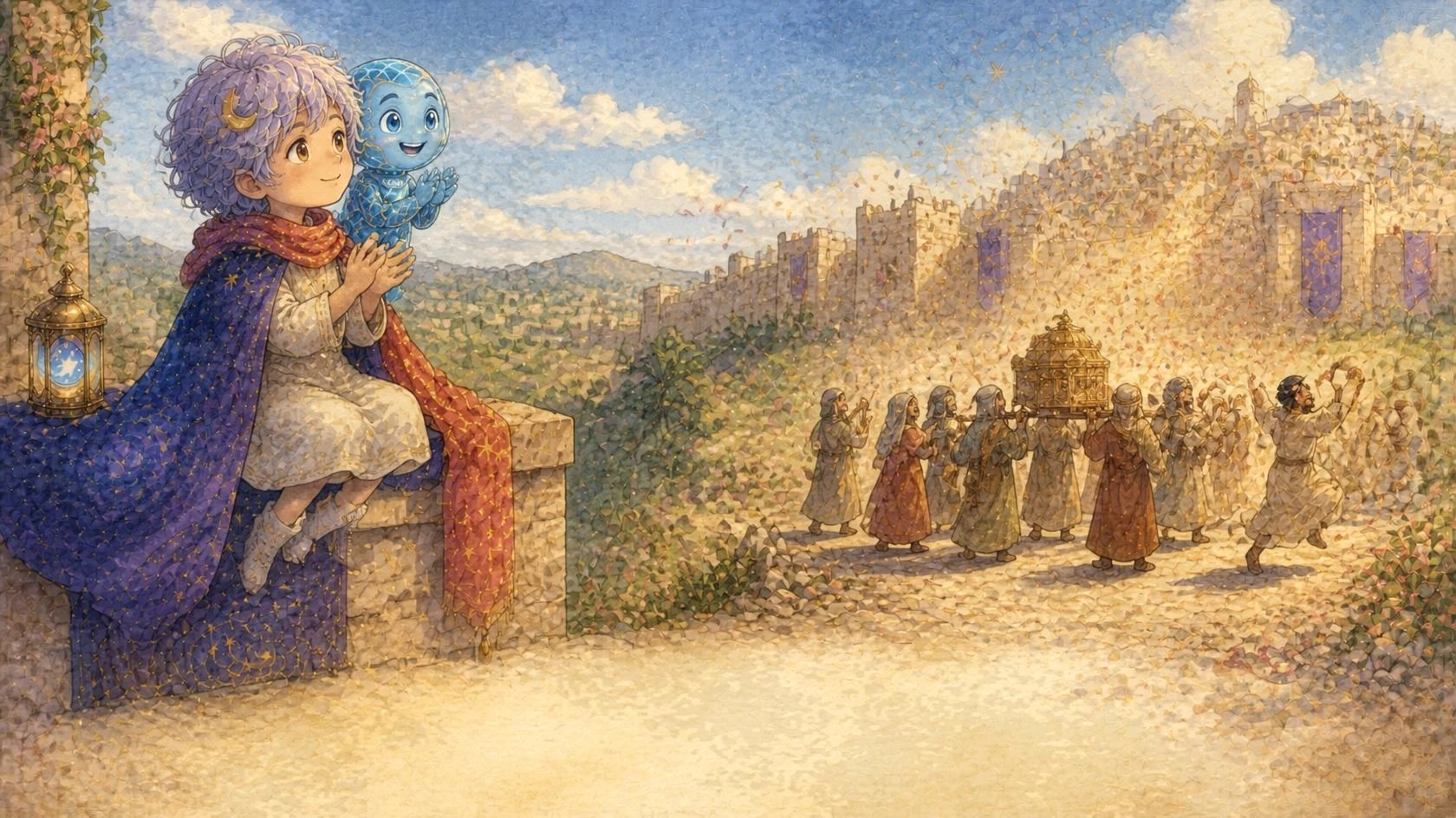
Dancing with all his might
In time, God made David king. David brought God's covenant chest to Jerusalem. Toot— trumpets, boom-boom drums! In a linen garment, David danced before God with all his might. Living in his palace, David said, Retold "I want to build a house for God." But God spoke through Nathan: Retold "I will build a house for you. A king will come from your family, and I will make his throne last forever." Komo clapped, then stopped. "Forever? But David will grow old someday…"
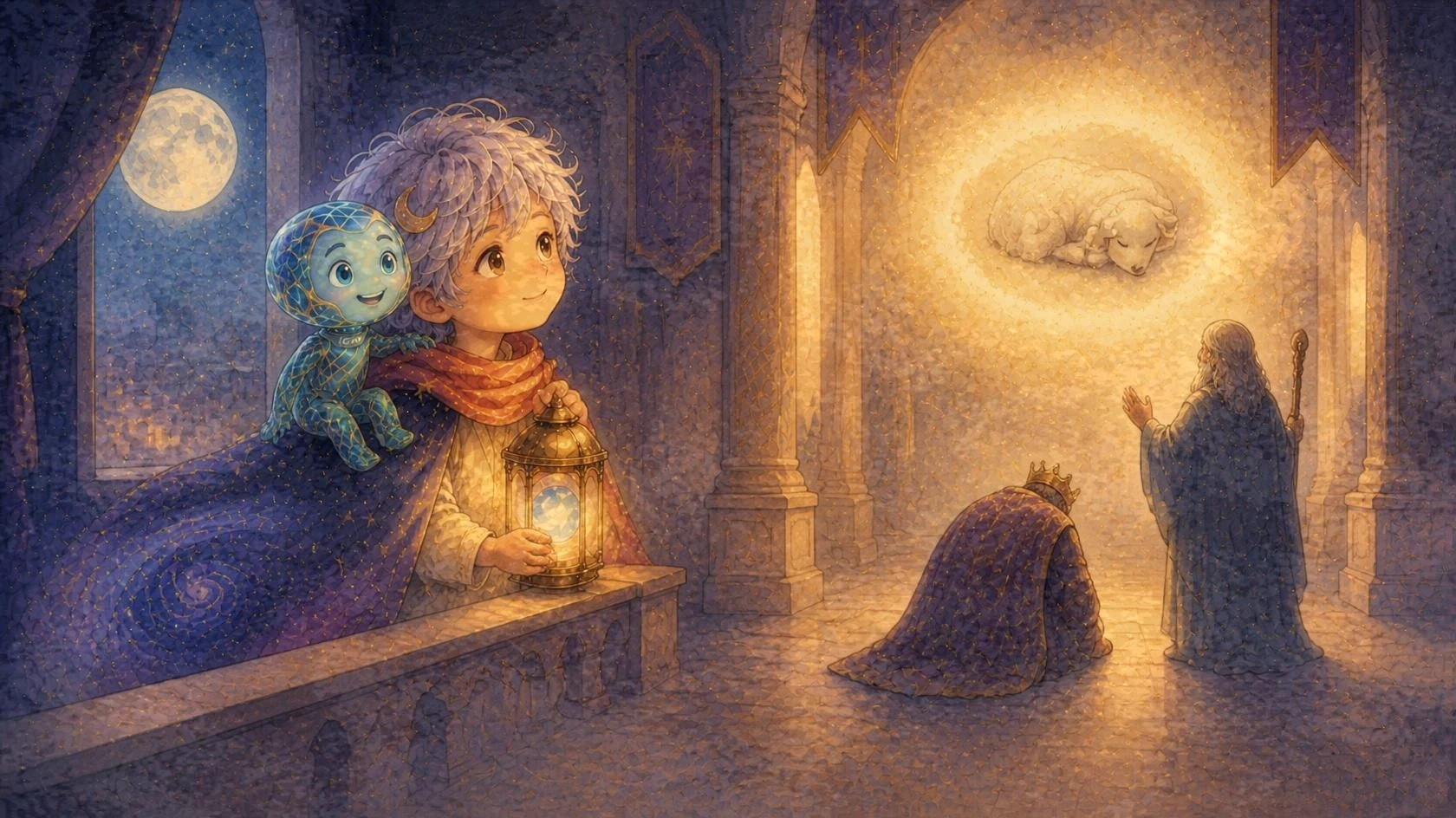
The only little lamb
Then King David sinned greatly against God. With a king's power he took the wife of Uriah, a soldier, and to hide it, he had Uriah killed in battle. "But the thing that David had done displeased Yahweh." God sent Nathan. Retold "A rich man took a poor man's only little lamb." David was angry. Retold "That man must be punished!" "You are the man." David hung his head. "I have sinned against Yahweh." Retold "God has forgiven your sin. But the pain this sin caused will stay in your house a long time." Nuri said softly, "God didn't pretend not to see. And God didn't throw David away."
The One bigger than the sky cares for little me.
Bigger than the sky
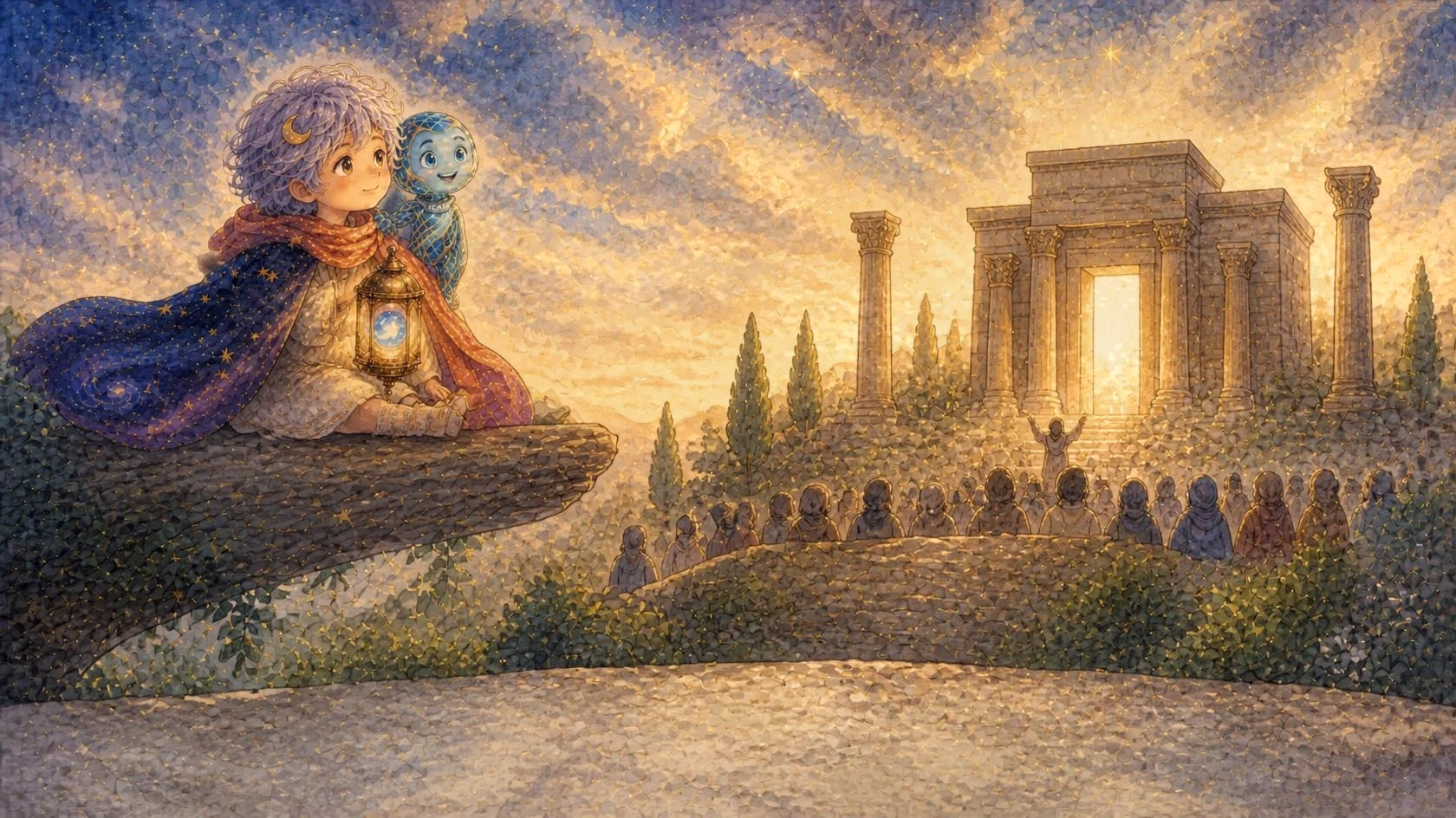
David grew very old and made his son Solomon king. In a dream God asked Solomon, Retold "What shall I give you?" Retold "A listening heart, so I can care for your people." Solomon built God's temple, the very house David had wanted to build. Solomon lifted his hands and prayed, "Heaven and the heaven of heavens can't contain you; how much less this house that I have built!" Komo looked up. "God is bigger than the temple, bigger than the sky. God made all those stars too."
A small, quiet voice
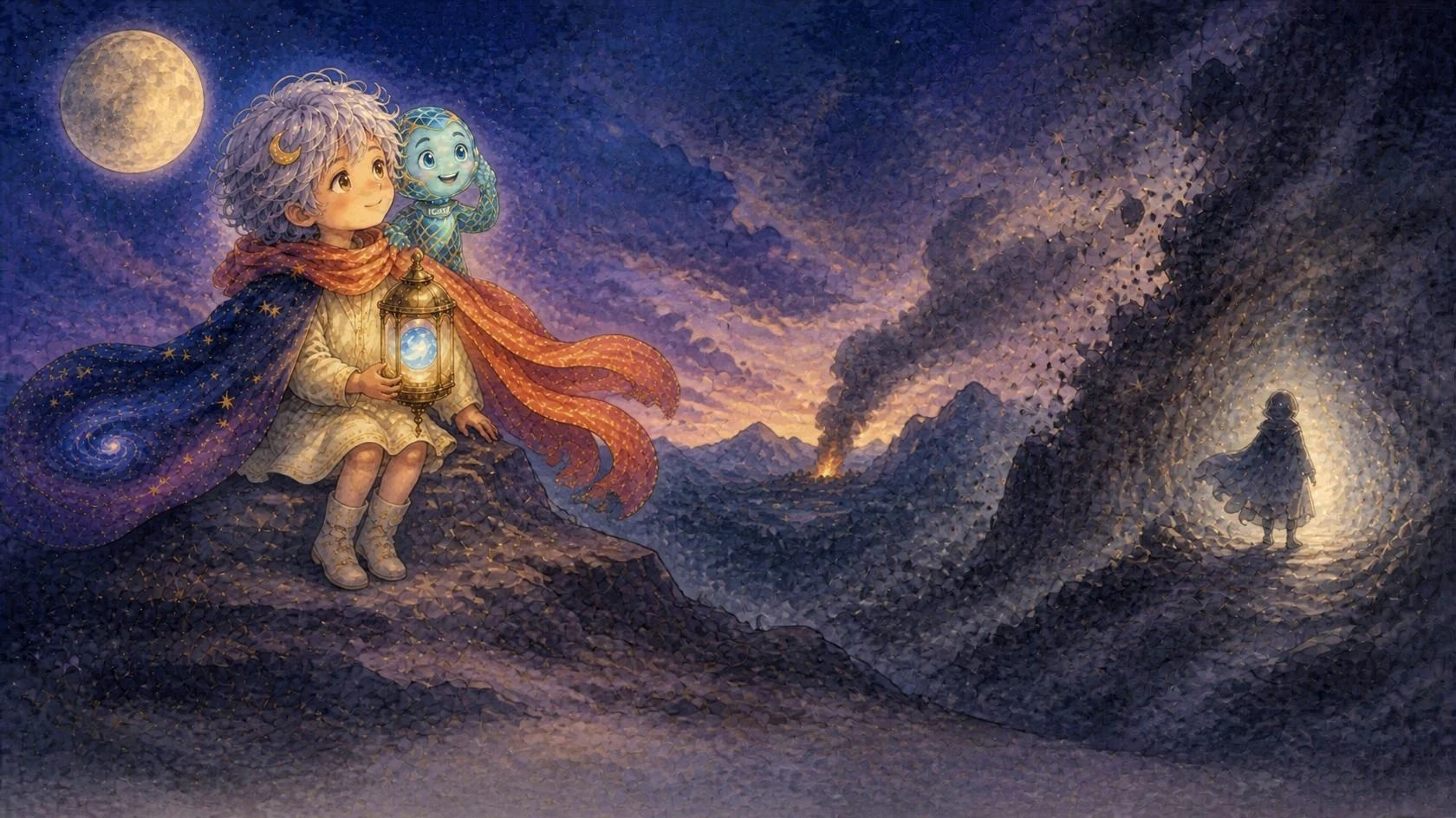
But when Solomon grew old, he followed other gods. After him the kingdom split in two. Many kings worshiped the idol Baal, but God sent Elijah. On Mount Carmel, God answered with fire, and the people cried, "Yahweh, he is God!" But when Queen Jezebel threatened to harm Elijah, he ran far away in fear. God gave tired Elijah food. Elijah went to a cave on a far mountain. Whoosh— wind! Rumble— earthquake! Roar— fire! God was not in them. Then… a small, quiet voice: "What are you doing here, Elijah?"
The shadow that went back
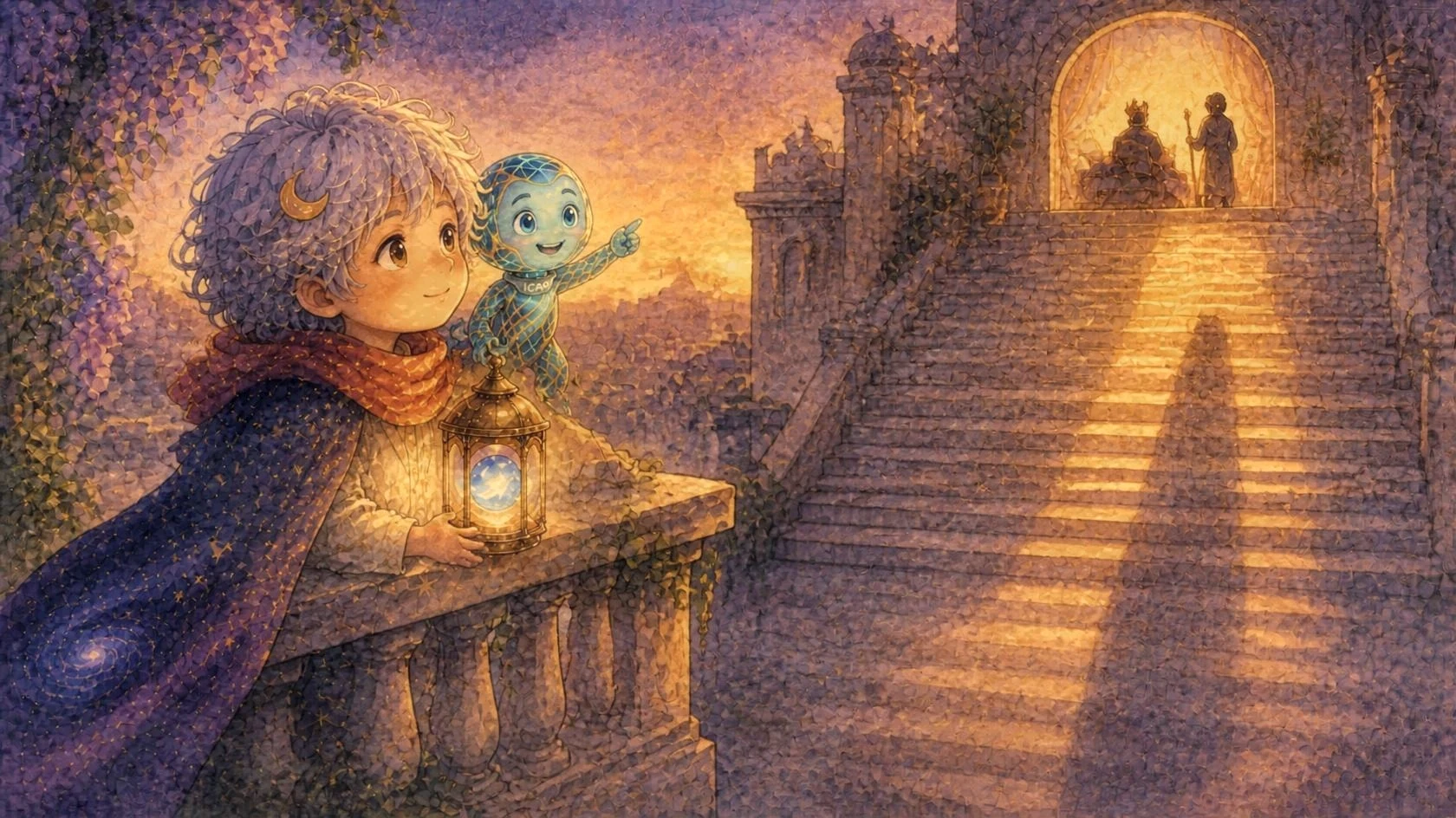
In King Hezekiah's time, Hezekiah became very sick and prayed with tears. God sent Isaiah: "I have heard your prayer. I have seen your tears. Behold, I will heal you." Isaiah prayed, and God made the shadow on the stair sundial go back ten steps. Hezekiah got well.
Later many kings and people left God. God loved them and sent prophets again and again, but they would not listen. At last Jerusalem fell, and the people were taken far away to Babylon. Still, God did not forget his people or his promise to David. He promised a way home.
The One bigger than the sky cares for little me.

The sky the shepherd saw
On the way home, Komo pointed up. "With his own eyes David probably saw a few thousand stars. But scientists estimate our galaxy alone has more than a hundred billion." Nuri said, "Stars don't decide anyone's fate. God, who made the stars, cared for David." "Hezekiah's stair shadow moved with the sun every day. But the Bible says that day God made the shadow go back."
- Our galaxy has about 100–400 billion stars. That is an estimate, not a count
- Because the Earth turns, the sun seems to move, so shadows change length and direction
A smooth stone at the window
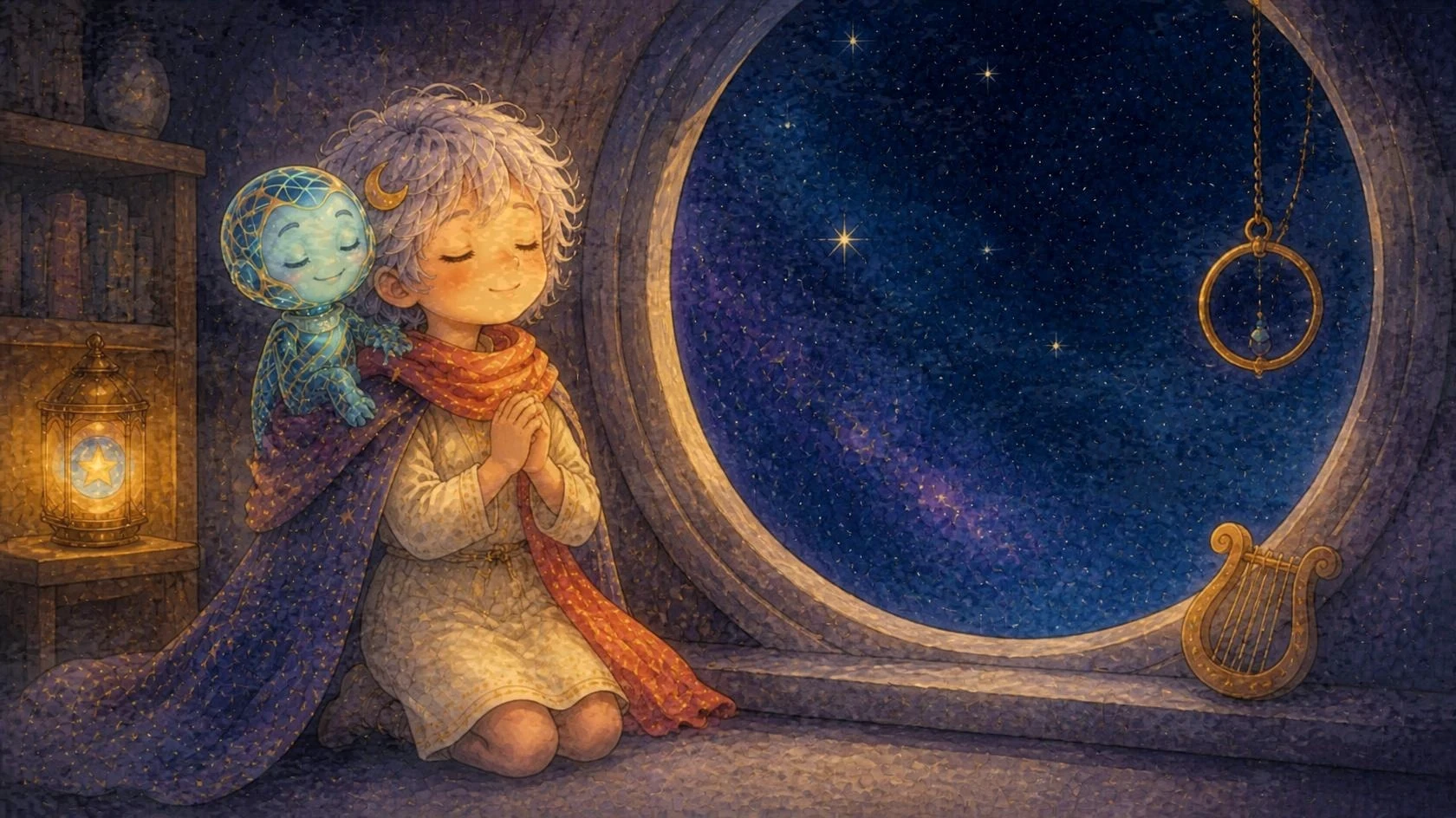
Back home, Nuri hung the star-ring in her window and looked at the little pebble. "It looks like the stone David chose from the stream. But it wasn't the stone that gave David victory. It was God." Nuri looked at Komo. "God, who chose the little shepherd, did not throw away David when he fell." Komo nodded. "God promised an everlasting king from David's family. The New Testament says that king is Jesus." Nuri closed her eyes and folded her hands. "God, thank you for calling me by grace. When I do wrong, help me not hide but come back to you. In Jesus' name, amen."
Eight Shepherd Star cards
Tap a card to flip it. Shuffle David's cards, then lay them in order on the star path and retell David's story.
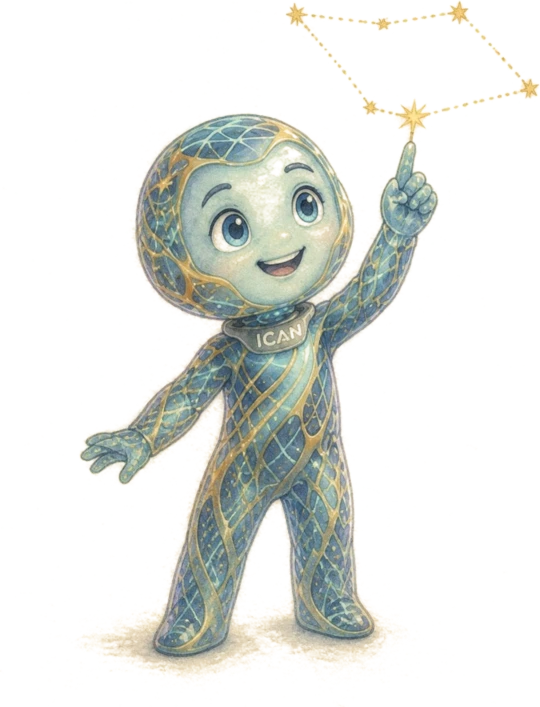
Four thinking games
- 1[Class] Understanding · David's star path: lay five paper stars on the floor and place the shuffled cards "Youngest shepherd–Smooth stones–Corner of a robe–Linen dance–Only little lamb" in order. The stars only mark the order of the story.
- 2[Class] Analysis · Two fires: draw the fire on Mount Carmel and the fire at the cave side by side, and name one thing the same and one thing different.
- 3[Home] Inference · Why didn't David harm Saul in the cave? Use the words on p.5 as your clue and tell your family.
- 4[Class] Prediction · Look at the back cover. In Homecoming Star, what will people do before the broken wall?
[Home] Tonight's sky: look out the window with your family for one minute and read Psalm 8:3–4 together.
What will I tell the One bigger than the sky today?

A 25-minute lesson and what to look for
- Prepare
- 5 paper "stream stones" (no real stones, or collect them after), 5 paper stars (star path), 8 cards (shuffled), two-fires drawing paper.
- Time
- About 25 minutes with pauses. For 20 minutes, move the p.4 inference to home. At pauses, hear two or three children; others answer with fingers or cards.
- pp.1–4
- p.1 plucked-string sounds → p.2 count the brothers on fingers, prediction → p.3 refrain as if looking at the sky → p.4 inference ("boom, boom" softly, once).
- pp.5–7
- p.5 read Goliath's death briefly and pause 3 seconds. If a child is upset, say "That can feel scary," and separate a war long ago from today's call to peace (Matt 5:9) → p.6 clap and dance → p.7 slow and low; pause 3 seconds after Nuri's words, then refrain.
- pp.8–12
- p.8 understanding (star path) → p.9 analysis (two fires) → p.10 pause 3 seconds after Hezekiah is healed → p.11 sky for 30 seconds → p.12 prayer. Don't use a flashlight to make a shadow go back (a miracle is not a trick to copy). If time is short, read only the box references.
- Words
- prophet = one who speaks God's message · anoint = set apart the one God chose · Philistines = a neighboring nation at war with Israel · covenant chest = box showing God was with his people (the box had no power) · idol = false god · sundial = tells time by shadow · sign = God showing his promise · Babylon = a great nation far east
- What to look for (by age)
- A record for choosing the next question, not a score. Ages 5–6: choosing a card or a one-word answer counts · 7–8: one clue · 9–10: two clues and a reason. p.2: "the youngest is left" + 16:7. p.4: sprout "he was brave" · stem "God was with him" · fruit links the lion and bear to now ("scared, but trusted and went"). p.8: order + confession at the fall. p.9: compares fire-answer and quiet voice.
Answer guide and hard questions ①
- Answer guide
- p.2: David comes and is anointed (1 Sam 16:11–13). p.4: trust in God who saved him from lion and bear (17:37). p.8: 1 Sam 16 → 1 Sam 17 → 1 Sam 24 → 2 Sam 6–7 → 2 Sam 12; the fall = the lamb; David confessed (12:13). Accept varied answers about feelings if grounded in the text. p.9: on Carmel God answered by fire (1 Kgs 18:38); at the cave God was not in the fire and spoke in a quiet voice (19:11–13).
- By age (p.7)
- 5–6: "What was taken from the poor man?" · 7–8: "What did David do after Nathan spoke?" · 9–10: "Why did pain remain after forgiveness?" For ages 5–6 you may read: "David took Uriah's family and, to hide it, let Uriah be killed."
- "Did Goliath die?" · "Can we fight to win?"
- "Yes, Goliath died (1 Sam 17:50). It was a sad thing on a battlefield long ago." Don't describe it. David trusted God, not a sword (17:47). It is not a fighting game to copy, and no one may use God's name to justify violence today. Jesus said peacemakers are blessed (Matt 5:9).
- "What happened to Saul?" · "What if someone wants to hurt me?"
- Saul died in battle, and David wept when he heard (2 Sam 1:11–12). Then God made David king. If someone wants to hurt you, don't hide alone; tell a trusted adult right away.
- "Why did David do that?" · "Was Bathsheba wrong too?"
- The Bible does not hide David's sin. God saw it as evil (2 Sam 11:27) and through Nathan said "you took his wife" (12:9). The blame belongs to the king who misused his power. Don't blame Bathsheba.
Hard questions ②
- "Why didn't God protect Uriah?"
- "We can't know everything. But God saw it all and called it evil (2 Sam 11:27). God held King David responsible. God does not forget people who are wronged."
- "Someone died, and David is forgiven?" · "Why does pain remain?"
- Forgiveness does not make sin small. God exposed the sin, and when David confessed, God forgave him (12:13). "A broken cup stays broken even after 'sorry.' The pain from sin stayed in David's house (12:10)." Don't bring up the baby's death (12:14–18) first. If asked: "David's baby got sick and died, and David cried and prayed very much."
- "If God always watches me, I'm scared."
- "God seeing you doesn't mean spying; it means caring (Ps 8:4)." When David did wrong, God did not throw him away but sent Nathan to bring him back. That's why the refrain says "cares for."
- "Was Elijah scared because he had no faith?" · "Isn't God in wind and fire?"
- Even Elijah, who did great things, was afraid. God didn't scold him; God gave him food and spoke quietly (1 Kgs 19:5–13). God is everywhere and once answered with fire (18:38). That day he spoke to tired Elijah in a quiet voice.
- "If I pray, will everyone get well?"
- God heard Hezekiah's prayer and saw his tears (2 Kgs 20:5). God always hears our prayers too. Sometimes he heals right away, sometimes after a long wait, and some people are not healed here but go to be with God. That is not because their prayer was not enough. At all times God sees our tears and is with us (Jas 5:16).
- "Why were they all taken away? Does God only punish?"
- God was patient for a long time and sent prophets again and again (2 Chr 36:15–16). They would not listen, and sad things happened, but God did not stop there; he brought them home (36:22–23). Families who move or are refugees today are not being punished. That is the next book, Homecoming Star.
Faith wording check
- Objects and stars
- The star-ring and pebble are story tools, not charms or holy objects. The pebble on p.12 only looks like David's stone; God gave David victory. The stars on the star path only mark the story's order. Stars do not decide anyone's fate. We praise God who made the stars (Ps 8).
- Grace, not moralism
- "Yahweh looks at the heart" (1 Sam 16:7) doesn't mean only good children are chosen; God sees differently and chooses by grace (16:1). David was not perfect, and God brought him back when he fell. Solomon also turned from God when he was old (1 Kgs 11:4).
- The everlasting king
- God promised to make David's throne last forever (2 Sam 7:12–16). This promise came true in Jesus, born from David's family (Luke 1:32–33; Matt 1:1). If a child asks, answer "It's Jesus." Don't match each of David's acts (the dance, the stone) to Jesus.
- Not covered · notes
- Saul's death (1 Sam 31), Uzzah's death (2 Sam 6:7), the baby's death (12:14–18), Absalom (15–18), the end of Baal's prophets (1 Kgs 18:40), Elisha, details of Jerusalem's fall (2 Kgs 25). The night in the fields on p.3 is the book's imagining; Psalm 8 is introduced as a song David wrote later. Boxes and unmarked quotes are WEB (some in part); "Retold" = easy retelling. Review and a timing test are advised.
아이캔 코모는 미래를 커젤로 바라보나 원더로 간구합니다.